Fall for Dance’s Program 3 at New York City Center kicked off with a firecracker of a young flamenco artist, Juan Tomás de la Molía, and a rousing trio of singers. Unlike the onetime enfant terrible Israel Galván, de la Molía seems less inclined to move fast and literally break things than to sweep us off our feet: part golden retriever puppy, part Top Fuel dragster. We hear him before we see him, pummeling the platform in the blackout as he leads the singers on.

Lights up: he faces them in profile, the most pugnacious of the four. They sing at him and clap out the compás; he fires back, in dance, his acquiescence and objections. The blur of his feet and lethal snap of his heels play against the twitch of a shoulder and the twinkle in his eye. He slips a shoulder out of his jacket with mock sexiness, then rips it off, balances it on a lifted foot and punts it away. His virtuosity lies in rhythmic precision and kinetic discipline, paired with a raffish upper-body ease. This Bulería was over too soon.


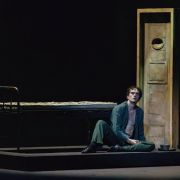
Virtuosity was likewise the subject of The Royal Ballet's Paganini – The First Virtuoso, which closed the program. Violinist Vasko Vassilev, pianist Pamela Tan Nicholson, and dancers Steven McRae and Sarah Lamb all dressed as incarnations of ‘the devil's violinist’ in tails and scruffy black wigs. New York saw only the second half of the work, directed by Natalie Abrahami and choreographed by Loughlan Prior; the first half, a multimedia account of Vassilev’s and McRae’s parallel journeys as prodigies in Bulgaria and Australia, may well be where its heart lies.
What remained was a thin conceit, soon buried under the clatter of McRae's over-miked taps. His tap dancing firepower, so central to his Mad Hatter in Wheeldon’s Alice’s Adventures in Wonderland, seemed undiminished by recent injuries; witness a smoking round of tap chaînés.

But tap did little to illuminate this impressionistic account of Paganini, and McRae’s antics – like stretching out on the piano lid, idly plucking keys while Tan Nicholson played – yielded diminishing returns. In the Bulería, the zapateado was integral to the discourse; here, the tapping came across like a toddler interrupting grown-up conversation. Pointe work by the delicate, fearless Lamb added little, though she did lean on the piano and unleash one of those crotch-baring développés with hinged torso, meant to look provocative but now so commonplace that 10-year-olds are doing it at YAGP.
Vassilev's sprezzatura, by contrast – in the gorgeous, plaintive Sonata No. 12 and the swaggering Moses-in-Egypt-on-one-string – brilliantly evoked the pathos, weirdness and bombast of the Paganini legend.
The best part was when McRae lifted the piano lid and a bunch of dry ice smoke gushed out.

Israeli choreographer Lior Tavori's bleak yet mesmerizing Crust filled the intervening minutes, making time stand still. Seven intrepid young dancers strayed on and off a Persian rug, springing into the air, fists flying, legs flinging, bodies shuddering or dropping silkily to the ground. One would shove or carry another off the rug, rarely with hostility, more like a prescribed task. Encounters were brief and impersonal, save one prolonged bout of sensual grappling. A cluster of dancers moved as one, arms reaching like the tentacles of coral. Elsewhere, bodies were piled like corpses, then miraculously revived.


The electronic soundscape sampled Laurie Anderson’s oblique critique of the surveillance state in Born, Never Asked and Simon & Garfunkel’s 7 O'Clock News/Silent Night, in which the carol sung during the 1914 Christmas Truce is overlaid with a 1966 news bulletin on Vietnam War protests, civil rights unrest, and the grotesqueries of the House Un-American Activities Committee. To this, the ensemble performed a ritual of unison floorwork on the rug in deepening shadow.

A potent symbol of a nomadic home, the Persian rug was barely visible except from the upper tiers, until one dancer dragged another by the ankles and it bunched up beneath her. We had been watching a high-stakes negotiation over territory we couldn't fully see; now the ground itself turned unstable, and an abstract struggle over space became a visceral conflict over home. Tavori has described Crust as a work about “Israel and the world, twenty-twenty-four,” about “forbidden pleasure” and “intrusion into territory with unclear boundaries,” in which, ominously, “not everyone will be taken to the future.”
Eight years ago, I reviewed Michikazu Matsune’s piece that re-created the absurd 2008 detention of an Ailey dancer at Tel Aviv’s airport, where border officials forced him to dance to prove his identity. Both Crust and Matsune’s Dance, if you want to enter my country! treat the body as a site of political negotiation, corralled in a space where belonging and freedom of movement are subject to interrogation and expulsion. Crust felt as if it went on forever, and not long enough.