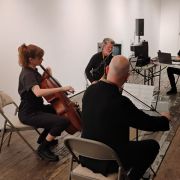
New York’s JACK Quartet is dedicated not only to performing the work of living composers but to fostering it. Their concert at the 92NY on Manhattan’s Upper East Side was comprised of four new works developed in their JACK Studio, including a commissioned premiere from the electrifying Tristan Perich.

Ailie Ormston’s New Paintings for string quartet and tape was a sort of double quartet, with a 4-channel electronic construction of string samples played through two Fender amplifiers (the Glaswegian composer is also a guitarist). The piece opened with a two-note bass line which the strings quickly, individually, joined with rubbery, wavering lines. Development came in between the cracks. The second movement was sharper, more crystalline again putting the strings in close formation against a somewhat static backing track. The third movement was a surprise, luxuriant lines against a drone-and-static backing track, something like wind in a tunnel. Ormston has an ear for asynchronous melodies which, in these short movements, proved easily likeable.


The Berlin-based Australian Jules Reidy is also a guitarist, and augmented their own guitar tunings for JACK’s strings. Shadow Symmetric started slowly, not like guitar music but quite like the lush sonic sculptures the composer builds with electric guitar through sustain and loops. Here, however, there were no electronics. Within the floating tones was what sounded to these ears like an old Irish folk melody played at quarter speed in easy rounds and full stops. Gentle dissonances, slowly introduced, were sumptuous.
The final work of the first half was part of a work in progress by the Edinburgh-born, NYC-reared Keir GoGwilt, himself a violinist. Future Mode 1, he explained, was written in just intonation and inspired by mid-18th-century musical treatises, combining improvisation and composition. After all that, it somehow sounded like bagpipes at first, maybe it’s the Scottish blood, but developed into something more complex, more layered, meshing nicely with the other two. He showed a penchant for dropping sudden ornamentation, repeating filigrees until they became part of the fabric.
Perich’s A Series of Short Works, Open-Ended, Somewhat Optimistic came after the interval and perhaps suggested something of a new direction for the New York native, who has done as much as anyone to define minimalism for the 21st century. Known for pairing groups of like instruments with simple, 1-bit electronic tones, Perich reduced the palette for what worked like a series of ensemble etudes, going from the dozens of small speakers he generally works with to just four, one for each JACK member.


His always fascinating work may have come to a bit of a culmination with the 2021 Infinity Gradient, for pipe organ and 100 speakers. Rather than working in electronic counterpoint, for this piece he put each player in unison with electronics. The ensuing tonality at times called the rigor of Kraftwerk to mind, at other times seemed like a string quartet articulated by artificial intelligence. The instrumental voices often seemed unplaceable even though the structure and methodology had been stated.
The effect was oddly cloying, not an uncommon response to Perich’s music. It undermines expectation. It’s exciting, engaging, riveting and distracting. It’s strangely easy to miss what a good writer and orchestrator he is because, by design, that part of his work is always partially obscured, even though the acoustic instruments are there taking up roughly half the sound space. The series of short works, a dozen or so, presented a set of singular ideas executed, explored and put to bed, with variations but not deviation. Oddly, it seems Perich’s focus has narrowed even more, and to exhilarating effect.