Time:Spans, now in its 11th year, is a strongly European festival in the midwest of Manhattan produced by the Earle Brown Music Foundation Charitable Trust and curated by the trust’s German-born artistic director, Thomas Fichter. This year's edition was a bit over half-European composers, and this concert felt especially so, although ‘nearly otherworldly’ wouldn’t be unfair.

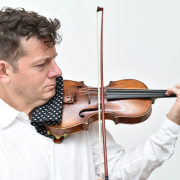
Chicago-based Kelly Sheehan’s 2026 O Maria began in near darkness, one spotlight on a large thunder sheet at the back of the stage. A foreboding drone grew, soon supplanted by baritone Ty Bouque’s guttural moans and audible inhalations. The lights came up and violin scrapes emerged via Sarah Saviet. The soundscape, performed by the SWR Experimentalstudio, also expanded, became impossible, larger than life. The real-time processing was dramatic but adhered closely to its sonic source, rather like cinema sounds design.


Bouque, a member of the vital New York City ensemble loadbang, possesses a magnificent voice, a broad range with dramatic sensibility, even in vocalise. His voice leapt out If only because we've learned since infancy to listen for voices. Saviet’s violin was fairly submerged within the structure eventually emerged broad strokes.
One question that arises with abstract music performance is how much of it is scored. Perhaps in this case all of it. A better question is, ‘Was the composer's vision realized?’ One can only guess, but the 15 minutes were cohesive and expressive. The real question, though (as with any music, really) is: What was the character of the piece? This was less than clear. There was an element of terror to it, culminating in Bouque approaching the thunder sheet and making soft sounds against its surface, played back loudly and enhanced. The piece was, in a word, ‘cool’, which isn’t the most emotionally resonant of qualities but hey, there are worse things.
In the second, longer piece – Philippe Manoury’s Le Temps, mode d'emploi, for pianos and electronics – the processing was more pronounced. The pianos started hard and fast, the four eyes of the GrauSchumacher Piano Duo fixed on the scores, as quick progressions swirled overhead. They slowed but the trills lingered in the air. After the initial rush, a prolonged deceleration resulted in (almost) conventionally beautiful music, dissonant and amorphous but trading on the lyrical voice of the instruments. Echoes accumulated and faded, time folded in on itself. Arpeggios doubled and multiplied, isolated bass notes morphed into roars, amassing into a strange beauty, like floating through rain clouds. The recurring motif was not one of musical phrasing but a vague sadness. The stage lights were up, but the piece worked better with eyes closed. There was nothing to be gained by watching the players or focusing on the direction of the ‘real’ sound. A house of mirrors is more fun if you forget, as best you can, what a mirror is.


Manoury’s works benefits from a quality almost too simple to say: a better electroacoustic composition is to be found if the processing were removed, a good piece would remain.