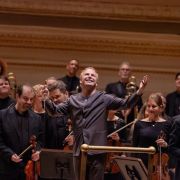
Gustavo Dudamel introduced himself to his new NY Phil subscription audience with a rendition of Mahler’s Symphony no. 5 that was at once surgically precise, startlingly forceful and compellingly human. Paired with a winning world premiere by Tania Leòn, it was as thrilling a consummation of the orchestra’s courtship of him as one could have wished. The orchestra will be taking this program on a European tour shortly.

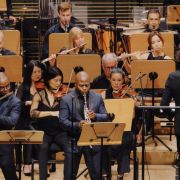
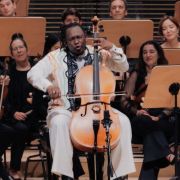
The Leòn piece, Imágenes Mestizas, is exemplary of her style: a high modernism that incorporates fleeting glimpses of various popular and indigenous musical genres. There was a definite pictorial element to this work, which puts us on a Caribbean island, presumably the Cuba of the composer’s youth. In the opening and closing passages, intertwining woodwind solos evoke a dawn chorus of birds, which then provide accompaniment for prayerful, sweeping melodies from the strings. In between, hints of groove enter with the brass, only to be interrupted by swarming percussion. A repeated jazz-adjacent riff said “tree frogs” to me, and a repeated clarinet solo in dialogue with the orchestra was that one bird that just will not shut up. It’s an engaging piece, performed here with clarity and enthusiasm.


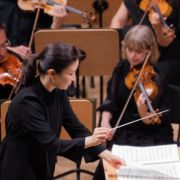
And then the Mahler. It’s not that I’d ever thought the New York Philharmonic was sloppy; but the level of precision they displayed here was extraordinary. It’s as thought Dudamel has them drawing with a finer nibbed pen. The delineations of phrasing seemed to trace along their Platonic ideals; the string sections sounded like a single player no matter the material.
Dudamel seems to think that Mahler, at least, should be allowed to overwhelm. The loud parts of this symphony were terrifyingly loud. At certain points the entire orchestra seemed to be a column supporting a cymbal crash. Not only the horns but the clarinets were often playing with their bells in the air. Even the violinists were leaning into their bows as though they were trying to break their strings.
All of which also served to make the quiet parts and silences even more telling. There was a clear and gripping emotional arc evident. The first movement, with its foreboding funeral march and outbursts, and the second, with its violent mood swings, evoked trying to come to grips with emotional wounds—and failing. The Scherzo was an attempt to regain joy, interrupted by unwelcome memories. The Adagietto showed resignation and the final movement the regaining of energy and swagger through simple joys.


Dudamel is renowned for his showmanship; the one bit of theatricality he incorporated here was asking principal hornist David Cooper to stand for the entire duration of the Scherzo, essentially positioning the horn, with its frequent solos, as the movement’s narrator. I’m not sold on the effectiveness of this; he was left standing with nothing to do for long stretches, and at one point we all got to watch as Cooper emptied his spit valve.
But that was the only dent in the evening’s triumph. Welcome to New York, Mr. Dudamel. It looks like it was worth the wait.