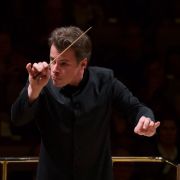
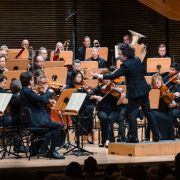
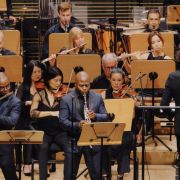
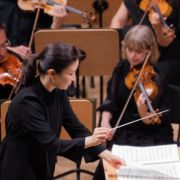
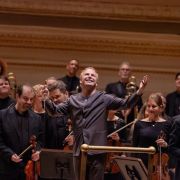
Abel Selaocoe is a force of nature. The South African cellist and vocalist is one of the most charismatic performers I’ve ever seen on a classical music stage, and composer Jessie Montgomery has channeled the securely virtuosic playing, the sweet tenor, the growling throat singing and the sheer dramatic energy of the man beautifully in her concerto These Righteous Paths, receiving its New York premiere with the Summer for the City Festival Orchestra of Lincoln Center, conducted by Music Director Jonathon Heyward.

These Righteous Paths is based on poems by Montgomery’s mother, composed in the years following her death. While very little of the sung text was in English, and even that not particularly intelligible (Selaocoe performed without amplification), the flow of complicated emotions came through clearly. Both composer and performer have an extensive set of influences and interests, and the three-movement piece works in elements of high modernism, texturally-based passages and a good many references to various elements of African music without ever sounding like a catalog. The most striking moments were those in which Selaocoe played or sang – or both – above mysterious, floating textures or energetic grooves from the orchestra, but his cadenza-like cello solos would have to be a close second. Selaocoe’s encore, a seemingly entirely improvised piece in which he invited the audience to create a vocal vamp (in two-part harmony!) for him to play over, was also memorable (and a great deal of fun).


The concert was titled ‘A Mother’s Love’. Besides the Montgomery, the other work that had a clear connection to the theme was William Grant Still’s Mother and Child, a piece for strings adapted from the middle movement of a work for violin and piano. This is a sweetly melodic piece, but not remotely cloying under Heyward’s baton; a somewhat less angst-ridden cousin to Barber’s Adagio for Strings, perhaps. The strings’ sound was transparent and the pace unhurried but not meandering despite its sweetness. This is the sound of a mother who loves you but who has a lot she needs to get done.

The rationale for the inclusion of Brahms’ Second Symphony on the program seems to be that the second theme of the first movement bears a resemblance to his famous lullaby. (They have their first seven notes in common.) But we shall let that pass. How did Heyward and the Festival Orchestra of Lincoln Center do with the Brahms? Remarkably well. If perhaps not always as polished as, say, the orchestra whose stage they share, the FOLC delivered lucid textures and thoughtful balances. The low brass, in particular, were deliciously solid without being overbearing. Brahms’ trademark off-beat rhythms were rendered meticulously and never allowed to become disorienting.
Heyward chose relatively quick tempi for the first two movements, which were welcome, although they did have the unfortunate side effect that the third movement, ostensibly the Scherzo, sounded little different from the first. But the energetic passages, especially of the finale, were beautifully exuberant. Heyward finally let go of the brass section’s leash and let them play out for the final moments, creating exactly the kind of electricity that makes the live concert experience worth the trip.