American Ballet Theatre brought back John Cranko’s Onegin in the second week of their summer season at the Metropolitan Opera House. This stunning production of the ballet based on Pushkin’s 1833 novel comes to life through emotionally charged choreography, lush countryside sets and richly textured costumes by Santo Loquasto, and a Tchaikovsky score brilliantly conducted by Ormsby Wilkins.

Against this lavish backdrop, the cast delivers compelling characterizations. Thomas Forster gives a powerful performance as Onegin, the archetypal “superfluous man” — well-bred, disillusioned and self-absorbed. Chloe Misseldine offers a naïve, bookish and hesitant young Tatiana who later blossoms into a regal, sovereign woman.
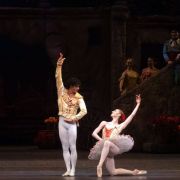
Zimmi Coker shines as Olga, Tatiana’s extroverted sister, whom we meet in the Act 1 preparations for Tatiana’s birthday party. Paired with Jake Roxander as her fiancé Lensky, they launch into a dreamy, open-hearted pas de deux. Roxander embodies the passion, idealism and youthful naïveté of the poet Lensky — qualities Onegin has long buried within himself. Roxander soars with the music, executing complex turn sequences with an open, adoring posture, while Coker meets his energy with fluid technical precision, making for a thrillingly cohesive pairing.


Onegin approaches Tatiana, glances at her reading material and quickly dismisses her as a foolish country girl — yet one still worth pursuing for her beauty. He lifts her abruptly, just to show off his physical prowess, then proceeds to peacock about the stage, dancing impressively before her rather than with her. His movements are heavy and starkly dramatic, conveying a world-weariness. There is nothing inviting about his dancing; it is performative and self-indulgent. Tatiana watches, bewildered by his behavior. She tentatively approaches him, as if to coax him off a ledge. He maneuvers her into impressive lifts, but their dancing remains disconnected, as he is too consumed with his own display. The corps brings a splendid burst of energy to this act, finally flying across the stage in swift, sleek grands jetés.
The mirror pas de deux, a dream sequence abundant in exalted lifts, is beautifully executed, notably the "torch lift", where Onegin hoists Tatiana by her ankle into a presage above his shoulder, a difficult lift to have her vertically stretched up way above his head.
Cranko translated the motivations and emotions of the characters into dance with great imagination. At Tatiana’s birthday party, a courtly Jarod Curley as Prince Gremin waltzes Tatiana tenderly and attentively, whereas Onegin’s waltz is stiff and obligatory.

Forster expertly portrays Onegin's psychological break and descent into obsession in the Act 3 reunion with Tatiana, in which he discovers that she is now the Prince's wife and has developed into a stately, elegant woman. He skulks around the perimeter of the dance floor, hunched and wild-eyed, hiding his face. He can barely look at Tatiana as she dances with her husband.
Curley’s Prince, again, was chivalrous with his bride and an absolute pleasure to watch. She glows in his reverent, protective hands, as Onegin’s shame deepens. He experiences psychological flashbacks – memories of Tatiana’s lost love and the tragic moment he shot Lensky – as the memories are reenacted between scrims. His face grows ashen and he moves like a feral animal. It is difficult to feel pity for him, for his anguish is not remorse for his victims, but for his own losses and the reckoning he must now endure.


The closing scene in Tatiana’s boudoir is magnificent. A desperate Onegin scrambles through her doorway, falls to his knees, begging for a second chance. He clings to her like a lifeline, encircling her body with his arms, then sweeps his arms beneath her shoulders like a rip current, pulling her back and down into his own chaotic abyss. She continues to trudge forward, dragging his dead weight across the floor behind her. Misseldine’s portrayal of the matured, headstrong Tatiana is admirable. She is careful not to give him any false hope, even when he manages to kiss her. Finally, she tears his love letter to pieces and orders him to leave. Once alone, she looks up into the light and lets out a silent wail. Is she regretful? Is she pitying him? Is she purging the toxic encounter? Is she simply relieved to be free of the parasitic narcissist? The audience is left to wonder.
This deliciously dramatic production of Onegin continues through June 27th at the Metropolitan Opera House.