It was 1958 when John Cranko created, for La Scala Ballet, his own choreographic vision of Sergei Prokofiev’s best-known ballet at the Teatro Verde on the island of San Giorgio Maggiore in Venice. Romeo and Juliet was originally conceived as a co-production with Teatro La Fenice, with a very young Carla Fracci in the role of Juliet. A few years later, Cranko created the definitive version of his work for Stuttgart Ballet, with sets and costumes by Jürgen Rose, during the very period in which the legendary Stuttgart Ballet miracle was beginning to unfold.

A version of the work by the greatest playwright of all time, filtered through the choreographic vision of the South African artist, which Teatro dell’Opera di Roma has presented for more than three decades, remaining remarkably faithful to that essential aspiration of “bringing men and women to the stage, with all their contradictions and emotions”, a principle our unforgettable artist often cherished and expressed.


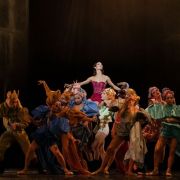
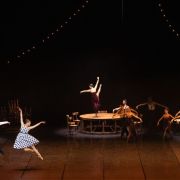
It is to this authenticity, credibility and spontaneity that Ballo del Teatro dell’Opera di Roma returns once again, as part of this year’s summer programme presented at the Circus Maximus. A spontaneity in the characters’ movements and in the relationships between their inner lives that the company led by Eleonora Abbagnato continues to explore and reveal with unwavering conviction and remarkable strength, here further enhanced under the expert choreographic supervision of Reid Anderson-Graefe. In Jürgen Rose’s sumptuous staging, the dancers appear to have fully embraced that seamless narrative and choreographic fluidity, one that never overlooks even the smallest and seemingly insignificant detail — a defining trait of the aesthetic world of this Romeo and Juliet.

Two performances that gave Susanna Salvi and Michele Satriano the opportunity to rediscover the intense dialogue between the two protagonists of this ill-fated love story, through a development that narrates, moves and reveals a depth in the two lovers of Verona that never loses its lightness and authenticity. With Salvi and Satriano, Cranko’s analysis is brought to life once again with conviction, recalling that spontaneity of expression which is always marked by originality and supported by an effortless technical command.

A special mention must go to the trio formed by Gabriele Consoli as Mercutio, Mattia Tortora as Benvolio and Claudio Cocino in the role of Tybalt: three artists distinguished by their incisive stage presence, technical precision and convincing characterisation of their respective roles, particularly in the tragic conclusion of the second act. The cast observed on this occasion appears to have fully embraced the essential principles underlying the construction and architecture of the characters conceived by the choreographer, reaffirming the excellent form of the company. With remarkable cohesion, energy and interpretative quality, they sustain a production of great commitment and considerable technical challenge.


Balance and sensitivity distinguished Ido Arad’s conducting, although occasional metallic overtones attributable to the amplification system sometimes prevented a fully satisfying perception of the orchestral palette. A compromise that is almost inevitable in open-air performances, but one that is richly offset by the unique allure of the opera and ballet evenings that Italy so beautifully offers.
Following the summer break, the next appointments with dance in Rome are scheduled for October and November, with the Icons of Dance Gala and a contemporary triple bill that will pair Marco Goecke’s choreographic interpretation of Petrushka with Jerome Robbins’ Afternoon of a Faun and Pina Bausch’s staging and choreography of The Rite of Spring.