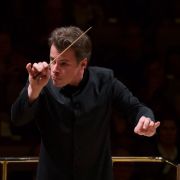
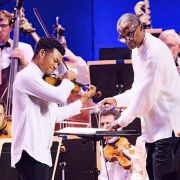
The Philadelphia Orchestra hosted Augustin Hadelich in Barber last month, and next week they’ll welcome Hilary Hahn playing Prokofiev. But virtuosos abound in their own string section too, and last weekend they ceded the spotlight to David Kim, Concertmaster since 1999. Kim demonstrated the stamina and drive required for Tchaikovsky’s Violin Concerto in D major, complemented by juicy orchestral accompaniment under guest conductor Rafael Payare, though some elements of the performance suggested why section musicians don’t always translate into ideal soloists.

Kim delivered the Allegro moderato with not a hair out of place, but sometimes in this music you want a bit of mussing. He thoughtfully articulated every note, turned dynamic shifts on a dime and even conjured a sense of wild reverie in the cadenza, though he seemed most at home in the prettiest lyrical passages. Tchaikovsky’s sound world here is obsessive and romantic – both in the capital and lower-case senses of the word – and Kim had a tendency to linger on one bright color, to constrict phrases rather than to shape them outwardly. Contrast that with the generous rubato and the enveloping melodies evoked by Payare in the orchestra and the sense emerged of a soloist and the forces at odds.


The elegant Canzonetta found Kim in his natural habitat, but the transition to the lively steeplechase of a Finale sounded somewhat attenuated. Again, precise intonation and making every note count individually were the order of the day, but I wanted a greater sense of sweep alongside the accuracy. Payare delivered that; he might have been better paired with a more extravagant soloist.
Two relative rarities filled out the rest of the program. The Philadelphians gave the US premiere of Falla’s El amor brujo in 1922; it was heard again here in a 1986 reconstruction by Antonio Gallego that restores significant portions of spoken dialogue. The end result sounded somewhere between monodrama and zarzuela, and Flamenco singer Marina Heredia intoned the passages with fluid narrative authority. In sung movements, Heredia’s dusky voice was expressive but rough-edged; while respecting her artistic tradition, I missed a classical singer’s vocal allure. Payare struck a strong balance between rusticity and glamour in the orchestra, although the narrative structure of the complete work sometimes sagged. Oboist Peter Smith brought a particular zest to the familiar solo in Ritual Fire Dance.
The concert also included Devil’s Promenade, a 1973 tone poem by Native American composer Louis Ballard (1931-2007). This was the first time the Philadelphia Orchestra played any music by Ballard – a member of the Quapaw Nation and often described in his lifetime as the dean of Native American classical music – and after hearing it, you had to wonder what took them so long. Named for a rural road near the area of Oklahoma where Ballard was born, the musical language of Devil’s Promenade emerges through patterns and phrases that pass among the orchestra, repeating and transforming along the way. Erica Peel’s piccolo called the work to order with a beguiling sense of ritual. The arresting introduction, which found the strings mimicking percussion by rapping their instruments before gradually plucking and bowing, built from a whisper to an overwhelming wall of sound, joined by woodwinds and brass. Despite a lack of traditional development, Payare respected Ballard’s narrative logic and kept the listener rapt.