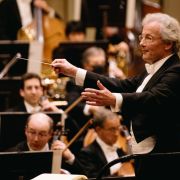
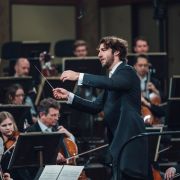
Mahler’s Ninth feels less a symphony than a force of nature: pressure fronts, fault lines, sudden clearings and storms that seem to gather from within the earth itself. Its scale is immense, but what makes it truly fearsome is not sheer size. It is the way Mahler asks a gigantic orchestra to behave, moment by moment, like a federation of chamber ensembles: solo winds confiding in one another, strings splintering into intimate speech, brass arriving not as reinforcement but heralding catastrophe. Conducting it must feel like wrangling an octopus, each individual limb animated by its own logic. That Sir Simon Rattle brought the whole thing to shore in the Musikverein – without a score and before a packed and unusually unruly hall – was an achievement in itself on an over-warm Friday evening in April.


The first movement, with its halting pulse in cellos and harp, began almost casually, as if the music were testing whether it wanted to exist at all. Many have heard in that irregular rhythm an echo of Mahler’s damaged heart; whether or not one accepts the biographical literalism, the opening undeniably falters before it flowers. From there the music swelled into multi-layered late-Romantic breadth, at moments almost Straussian in contour, then recoiled into textures so spare they seemed to breathe with difficulty. Rattle embraced both extremes: the overripe, the brash, the glaringly excessive, but also the terrifying withdrawals into near-nothingness. The Vienna Philharmonic were in good, if not flawless, form: strings capable of both terrifying weight and threadlike suspension, winds characterful to the point of dramaturgy, and brass willing to trade polish for sheer expressive force.
The second movement’s Ländler, grotesquely stylized, tilted peasant dance into something sardonic and unstable, its irony worn openly. Then came the Rondo-Burleske, Mahler’s great engine of derision: machine-like, densely contrapuntal, anti-elegant by design. Here Rattle and the orchestra were at their best, keeping the proliferating lines sharply profiled even at full tilt. The final frenetic coda had the effect Mahler must have wanted: not virtuosic exhilaration, but a kind of breathless spiritual abrasion.


After that, the Adagio arrived like a human voice recovered after fever. Thereafter, the unison opening to the Lied-like finale feels like such a respite, after so much madness and figuration, to have a warmer, cantilena driven song painted in larger strokes is a relief, even if that song is melodically reminiscent of the fourth Kindertotenlied. In closing, Mahler gradually strips the texture bare until only the thinnest thread of string sound remains, the music marked to die away into silence. A cell phone rudely punctured one penultimate hush, but the final pages were blessedly granted the fragility and hush they require. As the ceiling panels opened and a breeze moved through the hall, the symphony’s last exhalation seemed to suspend time. For a moment, turbulence gave way to balance, and both life and art felt briefly, improbably reconciled. The evening ended as the composition seems to ask that it should: not with triumph, but with release. After all the turbulence, the final silence felt less like an absence than a hard-won form of peace.