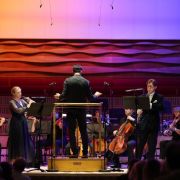
The Royal Liverpool Philharmonic Orchestra has received many four and five star reviews on Bachtrack this year and no wonder. It is simply a first-rate orchestra of superb musicians. It has a fantastic hall, a loyal and enthusiastic audience and attracts fine soloists and guest conductors. Things were not so good in 1880 when Max Bruch arrived from Germany as principal conductor. He had little that was positive to say about the orchestra, Liverpool or England and even then he was complaining that the only piece of his that everyone wanted to hear was his Violin Concerto no 1. The centrepiece of the orchestra’s last regular Thursday evening concert of 2025 was yet another performance of the concerto – and it was excellent.


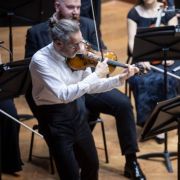
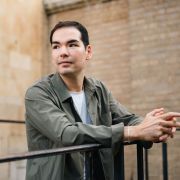
While we might like to hear other works by Bruch from time to time, this is the one that has held a place in the hearts of performers and audiences for over 150 years. The soloist, the young Swede Daniel Lozakovich, grabbed the audience’s attention from the start with his sweet tone, expressive playing of the work’s glorious melodies and his apparently effortless virtuosity. His quiet playing in the slow movement was breathtaking. But it was not just the soloist who made this a special performance: I was struck by the way Bruch provided the orchestra with exciting, stormy music which matched the Lozakovich’s fireworks but never overwhelmed him. The balance between the two was exactly right.
The evening’s conductor, Lawrence Foster, evidently had difficulty walking to the podium and conducted sitting down, but there was nothing frail about the playing he elicited. The Bruch was preceded by Liszt’s tone poem Orpheus. According to the composer’s essay on the work, it was inspired by an Etruscan vase depicting the mythological character and it invokes the civilising power of art. The magical opening, with solo horn and two harps, set the tone for the work. There were many more impressive orchestral solos. It becomes more dramatic (the growling basses suggesting Orpheus searching for Euridice, the conductor informed us) before returning to the mood of the opening. It is one of Liszt’s most restrained and concise orchestral works, predominantly light and airy, and it was favoured by Wagner and Saint-Saëns. It deserves to be more widely performed.


The second half of the concert comprised a performance of Tchaikovsky’s Symphony no. 1, which is full of youthful enthusiasm and in which, with hindsight, we can hear suggestions of the later symphonies and ballets on which the composer’s fame and popularity rests. It begins with one of Tchaikovsky’s loveliest melodies: above shimmering strings, Cormac Henry’s solo flute led us into this remarkable snowy landscape. His colleagues, especially the other woodwind players, created a magical atmosphere in these Deams of a Winter Journey, as the first movement is subtitled. The second movement is much less sombre than its title Land of Desolation, Land of Mists might suggest. Foster elicited some exquisite playing and ensured that every detail counted. The remaining movements do not have descriptive titles but I could not help wondering whether the startling loud timpani blows over quiet strings towards the end of the scherzo had some extra-musical significance. The end of the symphony is enthusiastic and jubilant (and perhaps somewhat over-the-top). Foster and the orchestra made the best case for it and brought the symphony and the concert to an exhilarating conclusion.