What is this shadow, anyway, and how many of the women on stage lack one? Barrie Kosky is as contrarian as ever in his take on Die Frau ohne Schatten: the usual “The Empress can’t have children” isn’t nearly interesting enough for him. In his new production in Aix-en-Provence, he eschews the much-explored extremes of orientalist fairytale and physical incarnation of Freudian psychology to give us a pared down stage in which the acting and music are paramount – albeit laced with generous helpings of theatrical effects.

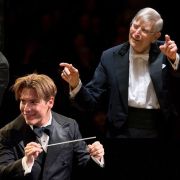
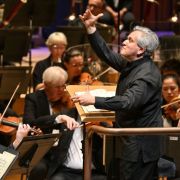
If anyone has the star power to upstage Kosky at the top of his game, it must surely be Klaus Mäkelä. Under his baton, the Orchestre de Paris gave a revelatory reading of Richard Strauss’s opulent, multi-faceted score. The term “broad orchestral palette” doesn’t begin to do it justice: we were treated to a veritable kaleidoscope of instrumental colours. Every contribution from a wind instrument or brass group was breathtaking; the low brass and contrabassoon – so important in this score in defining moments of intervention by the higher powers or fear of them – were having the time of their lives. The moments of mayhem – this opera was written during World War 1 – were explosive. The tender string ensembles were rich without ever overpowering.


The production revolves around the figure of the Nurse, the evil genius who controls – or tries to – almost everything important that happens. Nina Stemme ran the show, her vocal powers undimmed and her acting of this profoundly ambiguous character, torn apart by her misanthropy and her conflicting loyalties to the Empress and Keikobad, never short of compelling. Vida Miknevičiūtė was a sensational Empress. It’s a voice of rare beauty without a hint of harshness, and from her waif-like presence at the start, Miknevičiūtė grew in stature and vocal power to the critical moments in Act 2, when she banishes the Nurse. Victoria Behr’s Act 1 costume for her was a work of art in itself, producing the effect described in the libretto of light passing through her body unhindered.

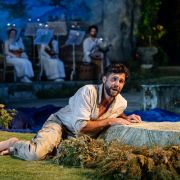
For the opening scenes, Michael Levine’s sets are bare and dark. As we are transported down to the world of men, Kosky springs the first surprise: Barak’s home and workshop is a multi-story creation of scaffolding and steampunk, compressed horizontally into a cramped and confined space which mirrors the condition of the dyers’ lives, expanded vertically to allow characters to inhabit different spaces simultaneously. It sets the scene for two heartrending moments: the orchestral interlude in which Barak and his wife – come together, understanding silently that in spite of all the harsh words, their life is hard and everyone does what they can, and later the chorus of the watchmen in praise of marital love and childbirth (echoes again of World War 1 and the need to repopulate). Brian Mulligan gave a fine depiction of Barak, who, in spite of his lowly status, is the one consistently noble character in the piece. Ambur Braid portrayed the wife as no mere heartless shrew, a complex woman driven first by circumstances and then by the Nurse into places that she does not wish to go.


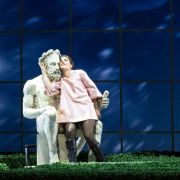
There are more coups de théâtre to come: the Young Man as an all-silver Greek God, danced brilliantly by Prince Mihai, the Emperor’s oration in Act 2 sung with authority by Michael Spyres on a giant rocking horse as he approaches the (unseen) Falconer’s hut, headless dancers in sparkling ball gowns as the fantasies projected by the Nurse, a show-stealing few lines from Héloïse Mas, high in the audience as the Voice from Above, a terrifying disembodied head on multiple legs incarnating the metaphor of the Emperor turning to stone.

For the last act, a true shock. The stage, which has been dark throughout, turns into an unadorned white cuboid, its walls so glaringly lit from all angles that no shadow could possibly be cast by anyone. And yet, despite all this light, Barak and his wife cannot see each other as they desperately traverse the ample width of the Grand Théâtre de Provence’s stage, to and fro. It’s gut wrenching, but the act gets even stronger and belongs to Miknevičiūtė as the Empress asserts the value of humanity to her father Keikobad in a voice whose strength and loveliness cannot be brooked.
Personally, I’ll go with the idea that the shadow is the human soul. But that’s personal: the point is that in this Frau ohne Schatten, Kosky and Mäkelä have allowed this most demanding of operas to speak for itself, in all its glorious complexity, confusions and contradictions, while providing high entertainment and high emotions throughout. It’s hard to believe that this was only Mäkelä’s second production in an opera pit: never accuse the Aix Festival of being risk-averse. This feels like the start of a beautiful friendship.


![Bachtrack: Classical Music Statistics 2024 [EN]](https://cdn.bachtrack.com/imagecache/1331/409761-m32-m290-505-screenshot-2025-01-17-at-16-55-55.jpg)