“Finally!” they muttered all around me as Hanna and Danilo kissed passionately after two and three quarters acts of witty dialogue, waltzes, a kolo, and ever so many emotional near misses in The Merry Widow. Yes, opera’s greatest romcom had the inevitably felicitous ending for both the happy couple and the Pontevedrian economy.

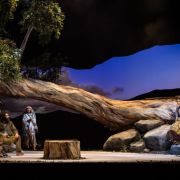
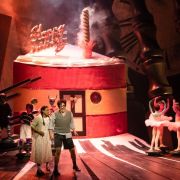
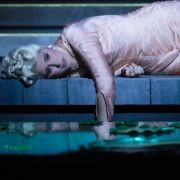
And those muttered responses were reflective of a delighted audience’s response to Lehar’s one hit operetta – it was the next best thing to musical, deserving applause for every sung number, Michael Scott-Mitchell’s Art Deco sets and both the acrobatic waiters and the can-canning grisettes at Maxims. For this third iteration of Graeme Murphy and Janet Vernon’s Merry Widow production for Opera Australia emerged as sparkling as the widow’s appropriately black dresses (Jennifer Irwin’s costumes), which glittered to match Julie Lea Goodwin’s scintillant soprano.


Could it be that this whole team from Murphy and Vernon’s erstwhile Sydney Dance Company had been involved in this reincarnation, for no revival director was credited? That’s not normally the case at Opera Australia, but is clearly desirable. Another novelty noted were surtitles in Chinese, appreciated by diasporic members of the audience. But were they a match for Justin Fleming’s witty English adaptation of the dialogue-heavy libretto?

For, somehow, between sundry flirtations, desperate French attempts to get their hands on the widow’s wealth and the Pontevedrian ambassador’s rearguard action to save that wealth for his bankrupt Balkan principality, Fleming allowed us to appreciate Hanna Glawari’s new freedom from both the patriarchy and her social limitations as a country girl. All that while accepting that Alexander Lewis’ Count Danilo was an aristocratic wastrel with all the charms of Hugh Grant, with whom he shared boyish looks and mannerisms not seen since Four Weddings or Notting Hill.

Fortunately, Lewis sang superbly too in a part that he was playing for the third time. Definitive, one might say. And, with both leads having had experience in shows like West Side Story (Tony) and Phantom of the Opera (Christine), their dancing was a match for their voices. Could their waltz duet, ‘Lippen Schweigen’ in have been bettered?

Matching the stars in both acting and voice were a stout David Whitney as the almost-cuckolded ambassador, Alexandra Flood as his flirtatious wife, foolishly in love with the ringing tenor of John Longmuir’s persuasive Camille, and Benjamin Rasheed’s embassy factotum Njegus, who caustically knows where all the bodies (and fans) are buried and manipulates every crisis with the diplomatic skills his boss lacks.

Tone matters, even in operetta. And while the directors persuaded us that Hanna’s wood-nymph fairy tale Vilja Lied was worth stopping the fun for to allow a mellifluous Goodwin to shine (and possibly identify?), they failed when it came to allowing a now over-merry widow to copy the grisettes in revealing her red knickers in a bottom-heavy end to the can-can.
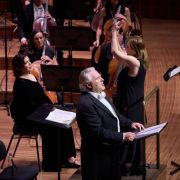
In the pit, Vanessa Scammell’s band, headed by the violins waltzing sweetly and harps in feisty form, kept the musical mood steady while many on stage were anything but balanced. I guess Jim Atkins’s minimally miked sound design was justified by five consecutive performances to open the run.