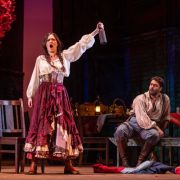
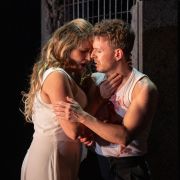
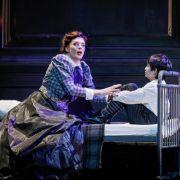
Tchaikovsky’s Eugene Onegin returns to the Sydney Opera House in a co-production which is over ten years old now, originally directed by Kasper Holten at The Royal Opera and revived here by Heather Fairbairn with a whole new cast and musical direction. Something of a vehicle for a young Nicole Car last time in Sydney, the role of Tatyana was taken here by Australian soprano Lauren Fagan, now well established internationally, who did not disappoint.

Mia Stensgaard’s set comprises a series of panelled square columns set about half way to the back of the stage, which is not a large one to start with, so limiting the scope of the action. Doors which close between them – sometimes curtains – allow, on the one hand, different kinds of interiors to be suggested and different scenic backdrops on the other. In the opening scene, with the peasants’ chorus, a scene of sweeping wheat fields can be seen and later a birch forest is suggested. One of the columns opens to display bookshelves, from which the dreamy romantic Tatyana makes her selection.


With respect to the grander scenes, the dancing in the Larin household is suggested more by shadows than actual dancing, contrasted with a more formal approach in the princely Gremin establishment, where couples come forward between the columns. The costumes of the upper classes are rather more later 19th-century than the 1820s of the original setting. In the first ballroom scene, all the guests were dressed in black, in contrast to Tatyana’s red gown and Olga’s green one, but the addition of lace pieces around the neck makes them look rather like servants.

Two dancers double the roles of Tatyana and Onegin, as their younger selves, “to explore how experiences and understanding of our own character colour our memories”, which seems rather otiose given that all that is entailed in the libretto and Tchaikovsky’s music. It is also a little confusing as to who is observing whom at different points, but at least they don’t intrude on the singing; one of those directorial conceits perhaps of more relevance to the director than the audience.
More successful is the staging of the conclusion of the first scene of Act 2, when Lensky in his jealous rage almost literally brings the house down, demolishing a chair and tearing one of the panelled doors off its hinges. The curtain then comes down, with the duel scene taking place after the single interval, a structural decision making dramatic sense.


Musically there was nothing to quibble with. Guest conductor Anna Skryleva, born in Russia but now based in Germany, led the Opera Australia Orchestra with flair and attention, providing a supportive context for the singers and drawing sumptuous sound from the players. The Opera Australia Chorus were as disciplined as we have come to expect, well coordinated in their movement.
In the title role, Ukrainian baritone Andrei Bondarenko was a compelling presence and sang with resonant smooth tone. He was well matched by Fagan, dramatically and vocally; singing with lovely rich tone, her rendition of the Letter Scene was an emotional tour de force, and her development from naïve dreamer to self-possessed princess was well depicted. Lensky was sung by Australian tenor Nicholas Jones with a beautiful plangent rendition of his signature aria (and a remarkably still corpse throughout the last act!).

Mezzo-soprano Sian Sharp was a creamy toned Olga and David Parkin a stiffly dignified Prince Gremin, growling convincingly sustained low notes. Helen Sherman as Madame Larina and Angela Hogan as Filippyevna both sang and performed warmly and Elias Wilson was a suitably fatuous Monsieur Triquet.