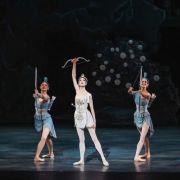
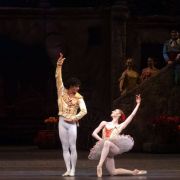
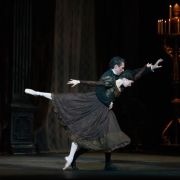
“The course of true love never did run smooth,” observes Lysander in Shakespeare’s A Midsummer Night's Dream. On Wednesday night at Lincoln Center’s Koch Theater, American Ballet Theatre echoed this timeless sentiment through a trio of contrasting works exploring both romantic and self-love. The highly anticipated world premiere of 21-year-old corps de ballet dancer Brady Farrar’s Trio Élégiaque turned out to be an elegant exploration of unrequited love. This was beautifully complemented by the company premiere of Jae Man Joo’s Flight, an angst-ridden solo powerfully executed by Herman Cornejo, and Frederick Ashton’s beloved classic, The Dream.
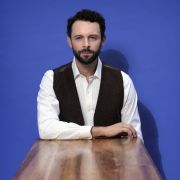
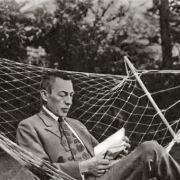
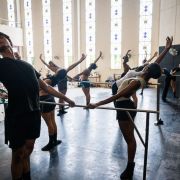
Farrar’s piece – set to Rachmaninov's Trio Élégiaque No. 2, a lament for his mentor, Tchaikovsky – revealed a sophistication beyond his years. Farrar utilized six of ABT’s virtuosic dancers alongside a world-class musical trio: Kobi Malkin on violin, Jonathan Spitz on cello and Jacek Mysinski on piano. Backed by excellent lighting and striking costume design, the production values were undeniably high. While a recent, splashy New York Times profile serves as a reminder of Farrar’s reality-TV roots on Dance Moms, his work here proves he is carving out a serious artistic identity. Ultimately, Trio Élégiaque is a well-staged, beautifully performed piece, even if its choreographic vocabulary feels somewhat limited at this point.


Three couples, distinguished by the distinct colors of their costumes, performed a series of pas de deux illustrating varying degrees of romantic resistance. Among the work's most striking moments was when Aran Bell encircled Devon Teuscher with his arms; though she appeared to return the gesture, her own embrace formed a broken circle hidden from his sight. Throughout the piece, tension was maintained through sliding drags, repeated attempts to flee an embrace, and a dizzying number of turns. Yet, these were balanced by gorgeous lifts, classic fish dives, and sudden pauses for solitary contemplation. While clean, clever and beautifully performed, the choreography ultimately suffered from repetition. At 21 it’s remarkable how much mature feeling Farrar has poured into his choreography; in time, his wider observations of human quandaries may expand his own movement vocabulary.
Herman Cornejo — who is set to retire this summer — delivered a searing performance of Jae Man Joo’s solo, Flight, appearing shirtless under stark lighting as cellist Jonathan Spitz played movements from Bach’s Cello Suites. Cornejo embodied a soul adrift, his internal struggles manifesting as a restless, pervasive angst punctuated by fleeting moments of peaceful lucidity. The demanding solo required near-continuous movement: explosive leaps, rapid turns, tai chi-infused phrases and sweeping upward reaches that occasionally left him drenched in light. Yet, inevitably, he was pulled back down to earth by the gravity of his own mortal coil. In the end, he abruptly flees the stage, leaving the audience to sit in a poignant silence, staring into the empty space left behind.
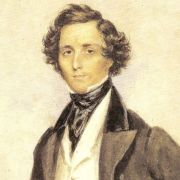
The evening culminated in the exquisite enchantment of Frederick Ashton’s The Dream. Set in a moonlit woodland governed by fairy mischief, the production brilliantly condenses Shakespeare’s five-act comedy into a seamless one-act ballet, propelled by Felix Mendelssohn’s majestic score.


On Wednesday night, Jake Roxander’s Puck stole the show; defying gravity at every turn, he danced with a buoyant brilliance that made the role feel uniquely his own. Catherine Hurlin offered a luscious, spirited Titania opposite Daniel Camargo’s commanding and regal Oberon. Surrounding them, the corps of fairies mesmerized the audience, their rapid, quivering footwork creating the illusion that they were hovering effortlessly about the stage. Roman Zhurbin’s Lysander and Patrick Frennette’s Demetrius provided comic relief in their mutual pursuit of Helena — played with hilarious verve by Courtney Shealy — while a thoroughly bewildered Claire Davison completed the quadrangle as Hermia.
A very special feature of the evening was a performance by the Young People’s Chorus of New York City, featuring solos by soprano Milena Manocchia and mezzo-soprano Lindsay Bogaty, all beautifully accompanied by the orchestra under the baton of David LaMarche.
Following the lively madness of the spell that briefly united Queen Titania with an ass — played with comedic perfection by Tyler Maloney as Bottom — the final pas de deux between Titania and Oberon was entrancing. As Oberon soothes her lingering impulsivity, their shared turmoil dissolves. Mirroring one another in an intricate, entwined embrace, their arms ultimately close to form a perfect circle of unity.
A well-rounded and highly entertaining program, An Elegy and A Dream concludes its run this weekend, offering the perfect magical fodder for the Halloween weekend.