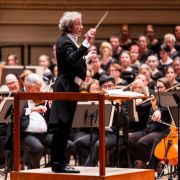
In their second offering of a two-night stand at Carnegie Hall, Franz Welser-Möst and The Cleveland Orchestra presented a program of maximal contrasts, pairing a Mozart symphony with a Shostakovich symphony. Though both are four-movement conceptions written at the height of their composers’ maturity, the coupling revealed just how elastic the very idea of “symphony” can be.

Under the Austrian conductor’s baton, Mozart’s Jupiter was a study in polish and refinement. Bold and effervescent beginnings revealed Mozart’s final symphony as his grandest, before giving way to lithe strings and gently tumbling winds. Tempos were brisk yet with ample room to breathe. Matters were under taut control, but the music still danced and there was certainly fire in the first movement’s development.
In the Andante cantabile, Welser-Möst and the Clevelanders mined Mozart’s lyrical core with delicate balance, though it was spiked with dissonances striking even to the modern ear. The Menuetto was fleet and featherlight, vigorous and with a flexibility that encouraged a charming abandon. With dizzying intricacies and lucid contrapuntal lines, The Cleveland Orchestra became a well-oiled machine in the magisterial fugue that closed.
Though Shostakovich’s Eleventh Symphony isn’t among the most frequently performed of his fifteen, to my mind it epitomizes everything Shostakovich stood for as a symphonist: politically charged and subversive, it employs a massive orchestra to convey the whole gamut of human emotion. Unlike Mozart’s abstract ideal, the latter symphony evoked a distinct program with the subtitle The Year 1905. Written a half century after the titular events, it recalls in uncompromising detail the horrific massacre of Bloody Sunday that eventually led to the Russian Revolution. The imagery is so vivid it’s nearly the confluence of symphony and film score.
It was in the Shostakovich that a great performance became a remarkable one. The opening scene at the Palace Square was of a desolate, eerie soundscape. Glacially paced, its stillness was only interrupted by the beat of the drum, chillingly portending what was to come. The 9th of January erupted into violence and chaos. Lurid and grisly, with garish juxtapositions, this is a symphonic movement unlike any other, portraying in no uncertain terms the brutal events of that day. The Cleveland Orchestra’s usual home of Severance Hall is rather more intimate than Carnegie, but they adapted to the larger space, ramping up the volume a few notches — and the effect was visceral.
Eternal Memory was a fitting response, with a hymn-like theme in the low strings swelling to deep resonance, majestic in its tragedy. The closing Tocsin (“Alarm”) was wild and unrestrained, given with red-hot intensity. An English horn solo was quietly forlorn, hanging on by a thread before the blazing brass and bells were rallied for the work’s shattering conclusion.