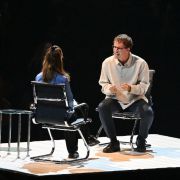
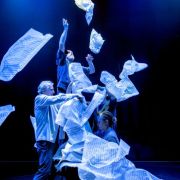
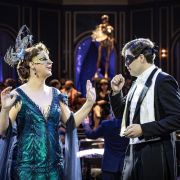
Family revelations have been something of a theme for Mark-Anthony Turnage lately. In his most recent opera, Festen, a Danish patriarch gets the whole family together to celebrate his birthday and gets more than he bargained for when his son reveals a history of abuse and the cause of his sister’s suicide. It’s not easy subject matter to live with, though it was its difficulty and black comedy that attracted Turnage to the story in the first place – all the big stuff: sex, death and betrayal. Almost universally hailed as a masterpiece – Andrew Clements called it “the most significant opera premiere of the last 40 years” – the opera saw a sell-out opening run and went on to scoop several prizes including two Olivier Awards.

This summer, in a programme that includes Sibelius’ Symphony no. 2 and Britten’s Cello Symphony, the BBC Proms hosts the UK premiere of Turnage’s Festen Suite, the latest in a long line of Proms commissions that have brought the composer’s visceral, eclectic and irreverent orchestral style to new audiences. But Turnage’s association with the Royal Albert Hall began long before he ever made his Proms debut.
“My mum used to take me to the Proms, starting when I was about 8,” says the composer who, at the age of 66 still looks, on this very hot day in London – in shorts, baseball cap and Beethoven t-shirt – as if he’s on his way to take up his place in the queue. Dedicated prommers, Turnage and his mother would stand reverently through the Beethoven they both found so thrilling before the young Mark was given permission to relax: any parent knows that there are limits, and the Proms has always had a commitment to new and sometimes challenging music. “There was a lot of Beethoven,” he remembers, “but they’d quite often pair it with Tippett, and my mum used to say to me ‘We can sit down for this bit.’”


Standing or sitting, the habit stuck, and teenage Turnage spent much of his summer holidays queuing to hear new music and for the excitement of seeing musicians up close. On one occasion – and he admits he was “unusual” as a teenager – he was nearing the front of the queue when he saw a security guard remonstrating with a man claiming to be a pianist who had left something in his dressing room. “I remember I had to go over and say ‘He is! I know who he is – that’s John Lill!’”
The idea that one day people would be queuing on the pavement outside the Royal Albert Hall to hear his own music was something, Turnage says, he couldn’t then have imagined. “At the age of 16 or 17, I never thought I’d be performed at the Proms, and then the first time was when Simon Rattle did Three Screaming Popes when I’d just turned 30.” He bought his mum a seat.
Since then, Turnage premieres have become a popular Proms staple. Who can forget the audacity of his 50th birthday commission Hammered Out – several classical music critics’ first introduction to Beyoncé? Then there’s the dazzling Time Flies, co-commissioned for his 60th, which takes the orchestra through three different time zones, London, Hamburg and Tokyo, morphing the forces along the way into one gigantic jazz band. The Festen Suite will give anyone who missed it a flavour of the opera that Turnage says “will probably turn out to be the most successful piece I’ve ever written.” Until the next one, perhaps? He laughs. The Royal Opera know a good thing when they see it and have commissioned Turnage and his librettist Lee Hall to write another. Both are way beyond second album syndrome but nevertheless, he jokes, there is a palpable sense of “Shit! What are we going to do next?”
Turnage’s trademark layering of contrasting musical textures proved the perfect way to peel back the layers of secrecy and collusion that drive the drama in Festen. Given the complexity of the music, the central role of the voices and the challenging subject matter of the opera, how has it been to re-immerse in that sound world and those themes? Has he learned anything new during the process of writing the orchestral suite? “Yes,” he says plainly. “That it’s very hard. A lot is lost and it’s all a bit of a compromise, which isn’t really selling it to anyone who’s coming to hear it, is it? I think the best opera suites are the ones that are thought of symphonically. You have to divorce it from the highlights of the piece.”

He cites Britten’s Four Sea Interludes from Peter Grimes as an example. “They work because they’re separate symphonic movements. So for instance there’s no music in the suite from Act One of Festen, not a note, and nothing from Act Three either, which is more of a coda. It’s all from Act Two in which has a lot of interludes anyway. The structure of the opera is very linear, so there are a lot of things that are ratcheting up. I’ve swapped a few things around, like the Conga,” the breathtaking all-singing, all-dancing scene in which each character’s individual rhythmic pattern is joined one to the other.


“The hardest thing is not so much selecting the music, but where you put the vocal lines and which instruments you use for them. Christian’s aria, in which he reveals everything that’s happened to him, is all there, but it’s embedded in the orchestra. There’s only one soprano sax in the opera, but there are two in the Suite because I use it to take over some of the vocal lines, which I think is a good solution. And there’s the cor anglais which is a very lyrical instrument. For Grandma’s aria, which is now a cello solo I’ve had to lower because the vocal part is too high for the cello, so I’ve stuck it down a minor third.” Linda’s aria, the devastating “All will be well” is in there too, the indelible moment that quietly dominates the entire drama. Turnage says it’s his favourite part of the whole opera.

One person who won’t be in the audience to hear it is Patricia Turnage – Pat – who died in March this year, aged 89. “It’s happening to a lot of people my age,” says Mark. “We’re all going through the same thing. My dad died a couple of years ago. We’re orphans now, it’s just what happens.” Clearing out the house he grew up in has been an emotional time. “It’s really strange, picking through people’s lives, and everybody says the same, that it’s been more heartbreaking than the funeral. They hoarded a bit. It’s all the stuff that you see.”
Although trawling through the family archive has been painful, not least because it has brought back to the surface his grief for the loss of his younger brother, he did make another discovery. “We found all these boxes my mum had kept – this is the weirdest thing, and we’ll never know, but she had loads of boxes of programmes of concerts I know she didn’t go to. Newspaper cuttings are more understandable, but there are all these programmes, so either she asked people to get them for her, which is unlikely, or she wrote to these organisations and got them, because I can’t see how else she’d have got hold of them. If she did write to somebody, I mean they’re not going to say no are they – especially if it’s a piece of mine. All these boxes of memorabilia, boxes dedicated to me. I never keep anything, I don’t keep programmes or reviews, so it’s amazing that she kept them all.”
It can surely only be a surprise to the man for whom music continues to be “an obsession” that the woman who so actively encouraged him in that direction would keep a record. And quite something to think of all those people in orchestral offices and concert halls across the world who have, with a knowing smile, popped a programme in an envelope and written the enclosure note, “Dear Mrs Turnage…”
Mark-Anthony Turnage’s Festen Suite is performed by Sakari Oramo and the BBC Symphony Orchestra at the BBC Proms on 28th July.