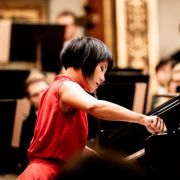
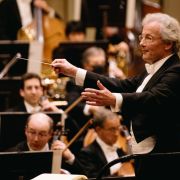
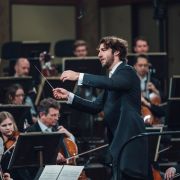
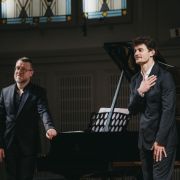
Rudolf Buchbinder wants to show me his billiard room. Above the baize hangs a caricature of Mozart, lining up a shot; beside it, a photograph of the Rat Pack around a pool table, and in the corner an antique slot machine. Then he presses a slim catalogue into my hands called Auf Ehre und Credit, from an exhibition on the composer’s finances. We fall into talking about how games of chance, and problems of honour and credit helped completely unravel one of the most gifted musicians who ever lived. While the mercurial Mozart never managed to build an institution, Buchbinder has spent two decades meticulously doing just that. As he approaches his 80th birthday and his final summer as artistic director of the Grafenegg Festival, Buchbinder talks about the festival he helped shape, the new hall that carries his name, and why, after all these years, he is more nervous than ever.

“For years I’d been asked to lead this or that festival, and I always said no,” Buchbinder says, “partly a matter of time, partly of control. There was always a catch: money, or politics reaching in. In Grafenegg there was none of that. The politicians support it and they don’t interfere. That, believe me, is a dream – it’s extraordinarily rare, if it exists anywhere else at all. It began with Erwin Pröll, then governor of Lower Austria, and Johanna Mikl-Leitner carries it on just as generously today.”
Buchbinder began his tenure at the Grafenegg Festival in 2007. Did he have a musical blueprint from the beginning? “Not a grand one. At the start there was only the Wolkenturm, the open-air stage. I remember a concert with the Czech Philharmonic that first summer: it rained, and they’d stretched plastic sheeting over the courtyard. The rain on the plastic was louder than the orchestra. It was untenable. Pröll simply said, ‘You need a hall’.” Within a year the new Auditorium opened. “That tells you everything about how this place works,” Buchbinder says.


Was there a moment he knew it had truly arrived? “In the first year, even the great artists – Renée Fleming and others – asked me, ‘And who has played Grafenegg before?’ I had to say: ‘No one. You’re the first.’ That they came anyway, on trust alone, moved me more than I can tell you.” In the years since, there are few major orchestras who have not made an appearance at the festival. “The remarkable thing is that in 20 years nothing has ever gone wrong. That’s my team – and word of mouth among musicians, the best PR machine there is. Nobody comes once and doesn’t want to return.”
This summer the new Rudolf Buchbinder Hall, in the renovated riding school, will begin to host its first concerts. I ask Buchbinder what it’s it like to sit in a room that carries his own name. “There’s a great deal of humility in it – and gratitude,” he says. “To be given a hall while you’re still alive to play in it... that’s a rare honour. And it’s a wonderful room. The aim was that it should suit every kind of music, and acoustically it does; you see from every seat and you hear from every seat. At the opening we put on voices, a quartet and piano – whatever we could assemble in the rush – just to test it and show what it can do. And it can do a great deal.”
And yet Buchbinder has said, quite bluntly, that it couldn’t be built today. “Not a chance. A project like that simply wouldn’t happen now, purely for financial reasons. There are cutbacks everywhere.” The project succeeded because it was initiated at the right moment, he says. “A few years later, and the riding school would still be a riding school.”
In the midst of all this change, Buchbinder’s faithfulness to his repertoire remains strong. Beethoven, Brahms and Schubert seem to follow him everywhere. I ask how he keeps works he’s played for decades from becoming routine. “Routine is no danger – quite the opposite. The older I get, the more nervous I become before every concert,” he says.
“There’s that long corridor at the Musikverein: I always compare it to the tunnel the lions walk through at the circus. My fingers are fine until I reach it – and then, suddenly, they go cold and stiff. Lorin Maazel, who seemed so cool and superior on the podium, which wasn’t true at all, gave me the best advice on nerves. Never play in the artist’s room the pieces you’re about to perform – God forbid something goes wrong, then it’s a catastrophe. Concentrate only on the first note. Everything else comes of its own accord.”
Does the music itself still change for you? “Constantly – and it should never be settled. I hope it never is. I recorded the 32 Beethoven sonatas in the early 1970s. 30 years later, Joachim Kaiser told me I had to record them again. ‘Why?’ I asked. ‘Because now you’re free.’”
“That stayed with me,” Buchbinder continues. “As a young man you think you can tear down the world; you’re inflexible, intolerant, narrow-minded. Beethoven, for me, is the most Romantic of all composers – the only one who writes a tempo after an espressivo, handing the interpreter an emotional freedom. His metronome marks, which people love to call unplayable, are really only there for the first few bars, to fix the character; after that you’re free.”
With the festival celebrating its 20th edition this summer, I wonder which concert of the 2026 programme best captures what Grafenegg has become. “One highlight chases the next,” Buchbinder says. “We open with Orff’s Carmina Burana under Cristian Măcelaru, one of my favourite conductors, and I close the festival with Riccardo Muti and his young Cherubini orchestra – his very first time in Grafenegg.


“Playing with him is pure joy,” Buchbinder says, of Muti. “He’s wonderfully funny; in Chicago he doesn’t retreat to the conductor’s room at the interval, he stays backstage with the musicians, cracking jokes. I first met him in Milan, in 1999. At the close I’ll play Mozart’s D minor Concerto with him, and earlier in the summer, Brahms with Lahav Shani and Beethoven’s Fourth Piano Concerto – which opens with the piano alone, about as intimate as a concerto can begin – with Fabio Luisi.”

Festival audiences have changed significantly in 20 years. I ask Buchbinder what a festival must offer to welcome new listeners without lowering its standards? “We have the Academy, the residency of the European Union Youth Orchestra, and tickets at less than 10 euros for young people. In effect, we run a kind of music education or music outreach programme. For a great many people, hearing a concert here was the first of their lives – and other venues benefit from that, too.” Neither is he bothered by audiences applauding between movements. “In Mozart’s day that was perfectly normal; if the applause was loud enough, they simply played the movement again. What could be better than that?”
Buchbinder himself marks a milestone this year, turning 80 in December. Has the way he listens to himself changed? “Not at all – I refuse to let it. Wilhelm Backhaus, asked what he made of critics, said they’d written the same thing when he was 10 as when he was old: ‘astonishing for his age.’ My own CDs are all still shrink-wrapped; I don’t listen to them.”
He talks about a recording of himself he has heard: performing Chopin at the age of eight. “It frightened me – how instinctively right a child plays,” he says. “The older you get, the more you read and analyse and pull the piece apart. That natural spontaneity is the thing you have to safeguard. And there’s something wonderful about this profession: it has no hierarchy. An 80-year-old is treated exactly as a 20-year-old is. That’s the dream of it.”
Buchbinder is soon to hand over the reins at Grafenegg to Johannes Neubert, until recently Managing Director of Orchestre national de France. Is he comfortable doing so? “Johannes was there from the very first hour – we sat in this room planning the early programmes together, before he went off to the Wiener Symphoniker and then Paris,” he says. “The hardest thing, as with any career, isn’t reaching the top; it’s staying there, holding the level. And it won’t get easier. Cargo costs have tripled; touring is harder every year – orchestras flying to Asia now leave their timpani and double basses at home.” Buchbinder remains stoical despite these increasing difficulties. “To every question there’s an answer,” he says.
Neither does age faze him. “Someone recently asked what I’d wish for at 90. I said: to still be able to walk out onto the stage the way I do today. On my own feet.”
The 20th Grafenegg Festival runs from 14th August to 6th September.
See upcoming events at the Grafenegg Festival.
This article was sponsored by Grafenegg Kulturbetriebgesellschaft.