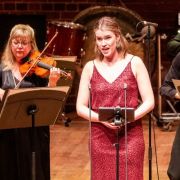
Wigmore Hall is 125 years old, and celebrating with an anniversary festival. Originally called Bechstein Hall (until 1917), this venerable venue will doubtless be unfazed by the new Bechstein Hall which opened a few steps away. After all, a rising international recitalist, vocal or instrumental, still excitedly awaits the career landmark of a Wigmore Hall debut. In her 2023 hall debut, Asmik Grigorian’s Tchaikovsky and Rachmaninov recital was a special night. Many Londoners also recall her appearances at the Royal Opera House in the title roles of Jenůfa and Rusalka. Here, as in 2023, her recital was given with her regular accompanist, Lukas Geniušas.

Their first half was devoted to a series of vocalises, thus opening a song recital by singing without any texts. Four of them – by Ravel, Fauré, Hahn and Messiaen – were called vocalise-étude implying a primary use for study and practice. I am not sure what four of the best composers of mélodie would have made of that, but we heard lovely wordless sounds, if difficult to ascribe to a particular composer, although Ravel’s was designated en forme de habanera so had something of his Iberian mode. But otherwise, denied a poem to respond to, these composers’ vocalising tended to sound alike. The exception was the last number before the interval, Rachmaninov’s Vocalise, the best – and best-known – example in the repertoire, because the Russian used the form to deploy his rarely rivalled gift for melody. The beneficiary (or victim) of so many instrumental arrangements, it sounded superb in this original, exquisitely sung.


Grigorian was indeed in fine vocal fettle, relishing the impact she can make in this hall of about 550 seats, with its frequently praised acoustic. Certainly her piano singing registered well, and her forte was not for the faint of heart. She was at her formidable best in the second half, a true song recital when she could respond to the taste and tang of a text. There was instantly an upgrade in the singing because fine singers deploy not just words but individual vowels and consonants to focus and inflect their sound and underline meaning. The rarely heard version of Richard Strauss’ Four Last Songs with piano, denied its glorious orchestral dress (so much more than an accompaniment), placed extra burdens on the singer. Thus in the wonderful last song Im Abendrot (At dusk), Strauss’ introduction is a pale reliquary, the only remains of his extravagantly passionate orchestral prelude. Grigorian seemed to smile beatifically while this long passage ran its now monochrome course, surely recalling the many orchestral concerts where she has sung the work. But as soon as she begun with her subtle, quietly confiding entry, little mattered except her heart-warming unfolding of this sublime number through to its closing “Ist dies etwa der Tod?” (Could this perhaps be death?). No, rather life in all its fullness.

Strauss favourites Zueignung (Dedication) and Cäcilie were welcome extensions to this enraptured mood. Less rapture was occasioned by the piano solos of Lukas Geniušas – a magnificent artist in his own right reduced to filling in with Bizet’s Chants du Rhin (four of the six) and Strauss’ Stimmungsbilder (three of the five). Even Geniušas would struggle to attract an audience to an evening of their piano music, distinguished as his pianism was throughout. But it was the prospect of Grigorian’s singing that had sold out the hall and, after the prolonged cheering and applause abated, she obliged with the essential encore, Strauss’ Morgen (Morning), the perfect close.