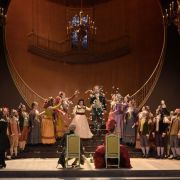
Thaddeus Strassberger’s new production of Bizet’s Carmen for LA Opera draws on Cristina García Rodero’s photographs from the 1970s and 80s and the paintings of the 17th-century masters of dramatic contrasts between Zurbarán and Ribera. The stage is rarely unoccupied by dancers, doubles or projections. Spectral figures hover at the edges and scamper through the action. Wrought-iron gates for palaces and prisons dominate a dystopian series of landscapes studded with exceptionally explicit violence. But Strassberger’s determination to make every image count sometimes leaves the opera itself struggling for attention.

The tough, working-class atmosphere brings to mind Jean Gabin and Ida Lupino in the 1942 flick Moontide, with its undercurrent of violence and social tension recalling Prosper Mérimée’s novella on which the opera is based. But the theatrical incidents accumulate. A helicopter delivers contraband to the smugglers’ hideout; an inevitable piñata takes its forty whacks; the Seguidilla becomes a Eurovision fantasy from which Escamillo emerges like Wayne Newton; the digital processing of Micaëla and the Santa Semana procession at the end are overwhelming. One admires the enterprise, even while wondering whether the next entrance will require air-traffic control.


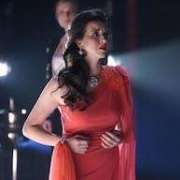
Whenever she was on stage, Rihab Chaieb’s Carmen took control. Garbed in Mattie Ullrich’s runway wardrobe, she conveyed authority, starting with her scenes with fellow prisoners and proletariat, where her chic blue workwear and knife-wielding decisiveness suggested a formidable Rosie the Riveter. But the sexual magnetism that makes Carmen dangerous proved elusive, her singing like her personna: direct and lacking a seductive lower register.

As a result, Kathleen O’Mara’s Micaëla stole the show in more ways than just sturdy purity of her voice and the innocence of her demeanor. New Music Director Domingo Hindoyan has described her as an angel, and the production makes the metaphor visible on a monumental scale. Her image expands into a giant projection that fills and rotates across the stage; spectral attendants bring her garments and a crown. Later, a funeral bier bearing her likeness dominates the bullfight sequence, where she watches the tragedy unfold.
The effect is spectacular, but it shifts the production’s center of gravity. Carmen, supposedly the woman whose defiance threatens the established order, finds herself competing with a Micaëla elevated into something approaching a secular saint. O’Mara’s direct, unforced performance made the contrast more striking still. The woman who ought to be Carmen’s moral alternative becomes the production’s most commanding presence – and its most monumental image.

Immersed in his world of obsession and violence, culminating in a brutally explicit final confrontation, Joshua Guerrero’s Don José sang with full-throated passion. Liam James Karai gave Escamillo considerable presence and vocal heft. Gabrielle Turgeon and Katie Trigg made an adorable Frasquita and Mercédès; and the chorus consistently had reserves of color and energy.


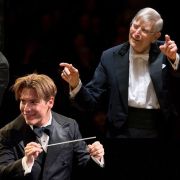
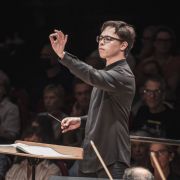
Hindoyan kept the narrative on a firm footing and the orchestra played with audiophile brilliance and clarity, including heartbreaking woodwinds and a magnificent solo French horn, and the orchestral sweep in the strings accompanying such gestures as Carmen’s throwing of the rose could not have been more expansive.

The production presents a coherent vision of a society that punishes those who refuse to submit. But its theatrical apparatus sometimes makes the argument before the characters have a chance to do so themselves. Strassberger’s imagery is so monumental that it might have been happier on the giant LED screens at Santa Monica Pier and Hacienda Heights, where the opening night was simulcast for free, than under the proscenium of the Dorothy Chandler.
Carmen can hold an audience without a helicopter and a funeral procession to assist it. The images will linger in the memory. Whether the people inside them do so quite as long is another question.