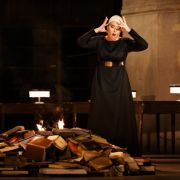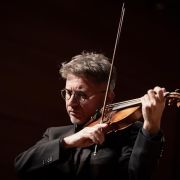


After a successful premiere at MusikTheater an der Wien in September, a new production of Francesco Cavalli’s La Calisto has finally arrived in Berlin, part of the Staatsoper Unter den Linden’s ongoing Barocktage. The reconstruction work often necessary to operas of this era – whose scores come to us as little more than vocal lines above a basso continuo – was undertaken by conductor Christina Pluhar. Concurrently, director Stefan Herheim transforms the tragicomic tale of deceit, sensuality and metamorphosis into an action-packed, galactic-bucolic story where cynicism and lust meet in a setting worthy of The Jetsons.

With operas as far in time and tonally varied as La Calisto, the swamp of ubiquitous irony is even more dangerous than the shallow waters of traditional mythological stagings. If nothing is to be taken earnestly, what is the point of sitting through three hours of music? Herheim’s production throws a good amount of bathwater out while also – mostly – retaining the baby. Disguises, mistaken identities, sexually voracious gods and satyrs all remain undiluted crucial elements of the narrative.


A healthy amount of middle-school humour is paired with remarkable craft from the costume, choreography and stage design departments. The forest where Calisto and Giove meet may be inexplicably futuristic, but it is also alive with animals brought to life by the corps de ballet and Jean-Paul Bernau’s beautiful masks. Yashi’s costumes for the satyrs, together with Beate Vollack’s choreography, rescues the instrumental intermezzos from the stagnant awkwardness that often plagues modern adaptations of Baroque operas.

Silke Bauer’s set designs reflect the more sensual, cosmic side of Calisto. Conceptually akin to Gustave Courbet’s painting The Origin of the World, the staging begins with several sets of concave neon side wings aligned as to recreate a vulva. Soon enough the stage opens up and the wings slide to the sides, now resembling the curves of trees and vegetation. Throughout the evening, minor adjustments in the position and lighting of these wings evoke a variety of settings, the most memorable being a starry sky and the lunar landscape that accompanies Diana and her nymphs.
The underlying, if occasionally ridiculed, pantheism of Giovanni Faustini’s libretto finds perfect realisation in Herheim’s production, where feminine and masculine, animal and human, divine and earthly mingle and unite in a common need to propagate the species. And if things get a little lost at the end, with Christian imagery complicating the picture, the sheer feat of having Calisto and Giove floating in a bed suspended by cables for a good ten minutes makes up for any loose ends.

A luxuriant, lush habitat was also the most immediate association suggested by Pluhar’s conducting. We know of Calisto that the limited means of Venetian public theatres at the time restricted the ensemble to strings and continuo; and with the opera being intended as amusement for a season, rather than for posterity, Cavalli left much of the stage music unwritten for musicians to improvise.
Pluhar filled these gaps with a new edition that imagines what Calisto might have been, had it had the resources of a prestigious court theatre. Joining together her ensemble L'Arpeggiata and Berlin’s Akademie für Alte Musik, the conductor rearranged the score to include several winds, an organ, percussion, two harps and a plethora of strings. Indeed, Pluhar’s Calisto found one of its distinctive traits in the variety of different plucked timbres, so that multiple moments felt like songs accompanied by an elaborate, kaleidoscopic guitar. True to Cavalli’s spirit, Pluhar encouraged improvisation, resulting in densely textured and rhythmic acoustic effects. Occasional imprecisions are a part of the package in these cases, the price to pay for a unique outcome.


Vera-Lotte Boecker’s Berlin debut as Calisto confirmed her triumph in Vienna. Richard Strauss and Janáček may sound like unlikely teachers for Baroque singing, but both ends of the repertoire require the nuance and vivacity that Boecker, a champion of 20th-century opera, clearly possesses, both vocally and scenically. The harmonic tension intrinsic in Cavalli’s oscillating melodies came natural and poignant to Boecker. While always intense and enthralling, Boecker’s silky soprano had its ideal counterpart – no offence to Milan Siljanov’s Giove – in the solo cello of “Piangete, sospirate”.

Subjected to a bottomless wardrobe of silly costumes, Siljanov offered an excellent performance as Giove, switching from an extroverted, round bass with a nice vibrato to an equally resonant mischievous falsetto. Around them was an abundance of talented soloists: Renato Dolcini’s charismatic Mercurio, courtesy of a pleasant, clear baritone; the two mezzos Luciana Mancini and Giuseppina Bridelli, respectively singing a smooth, soft Diana and curt, scorned Giunone; and Arnaud Gluck and Jake Arditti at opposite ends of the countertenor spectrum, the former all caught up in ethereal pianissimi as Endimione and the latter portraying a hot-tempered, vigorous Satirino.