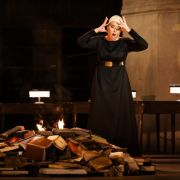
Anyone who has tried their hand at learning a piece of music knows that hours spent rehearsing inevitably set in motion a dialogue between performer and composer. For some musicians, this means striking up conversations with dozens of composers throughout their careers. For others, it is more natural to remain occupied with just a handful, in sustained relationships that may last decades. Among the latter is Swedish soprano Elisabet Strid, who over the past twenty years has built herself a reputation as a renowned interpreter of Richard Wagner.

In just a few weeks, Strid is scheduled to sing Brünnhilde in Vincent Huguet’s new production of Siegfried for the Accademia Nazionale di Santa Cecilia in Rome – the second instalment of an ambitious project that will cover the entire Ring by 2028. By now a veteran of the role, the soprano talks about her lasting affinity with (almost) all Wagner roles, and how each new production rekindles her passion for the repertoire.
“Even as a teen, when I hadn’t started singing yet, I felt drawn to Wagner operas. What fascinated me the most was this magic world of incredibly written music, telling complex stories with characters that feel alive,” Strid explains. “Then I began studying as a soprano, and that captivation only intensified. Naturally, during my training I got to know a variety of different operas; but delving into the scores and building characters through music, I got the confirmation that Wagner’s tauter, layered type of theatre gives me wings.”
Since her official debut at the beginning of the 2000s, Strid has gradually stepped in the shoes of almost every Wagner heroine. Her journey has been one of increasingly higher ascents: from Romantic operas like Tannhäuser and The Flying Dutchman to Isolde and – more recently – Brünnhilde, the soprano can now offer a bird’s-eye view on these roles.


“Despite the perception that some may have of Wagner’s female roles, I think that all these characters share a core of strength and willpower which is way more elaborate than it is made out to be, especially in the Romantic operas. Take Senta,” she reflects. “She goes her own way and meets her destiny as an outcast, just like the Dutchman does. Isolde and Brünnhilde are both ready to sacrifice everything for what they desire and believe in. In general, these women fight for their values and needs, for love and justice. My only exception is maybe Eva from the Meistersinger,” she jokes, “I struggle a little to understand her and make the character my own.”
Strid’s insights add depth to her performances, which have received enthusiastic reviews from both a vocal and actorial standpoint. Her upcoming stop in Rome will lead her into partially uncharted territories with the new Siegfried directed by Vincent Huguet, which will open the 2026–27 season at Santa Cecilia. A former student of Patrice Chéreau, Huguet has his own ‘Centenary Ring’ planned – not, like his teacher did, as an anniversary, but as a production that covers centuries of history. Working jointly with Santa Cecilia’s Music Director Daniel Harding, Huguet has re-imagined each of the four titles of the cycle to correspond to a wave of Italian imperialism, from ancient Rome to Italy’s colonial attempts in North and East Africa between the 19th and 20th century.
The scale of the project is better assessed against the backdrop of the Ring’s history in Rome. A complete staging of the cycle had been missing from Roman stages since 1961 and is a first-ever occasion for Santa Cecilia, which is usually mobilised as a concert hall. Huguet’s intention is, on a practical level, to push the limits of what the Auditorium can be by hosting orchestra, singers and sets all on the same stage; on a narrative level, to tell the tale of how empires come to be – through deceit, corruption and treachery – and how these faults taint their entire existence until they inevitably fall.

The first episode of Huguet’s saga already premiered last season with Die Walküre and concurrently marked Harding’s debut with the Ring. The two artists – some might argue, blasphemously – decided to invert the order of the operas, leaving Das Rheingold as a prequel for later seasons. While rehearsals for this year’s Siegfried are yet to begin in earnest, Strid is eager to embark on this new, unusual adventure.
“It won’t be the first time for me at Santa Cecilia or with Vincent Huguet – I have some great memories from when I sang Chrysothemis in his revival of Chéreau’s Elektra in Helsinki ten years ago. It will be interesting to see what he can do independently, with free rein. It will, however, be my debut under Daniel Harding,” she adds, “and with this incredible production. I find the idea so creative and intriguing. I was surprised to learn that the last full Ring staged in Rome dates back to the 1960s. Hopefully, a staging rooted in local history, together with some excellent performances, will bring Italian audiences closer to Wagner and prompt more frequent productions.”
With her debut in Götterdämmerung planned for the beginning of 2027, Strid will have completed the triptych of Brünnhilde operas. The role makes for one of the most complex character studies in Wagner’s oeuvre and is correspondingly demanding, both physically and interpretatively. Strid is adamant that a monumental role shouldn’t be synonym for monolithic, bombastic performances.


“In Siegfried, we meet a Brünnhilde that is entirely different from the character we know from Die Walküre. Her decision to follow her heart and defy her father costs her status and immortality, but at the same time she learns what it is like to be human, and the tragic beauty of it,” she explains. “The last act of Siegfried changes radically in music and tone from what came before. It would be impossible to convey the emotional significance of Brünnhilde’s awakening without being aware of the context in which it happens. This is why it is crucial to me to bring out the text clearly when I sing, shaping each phrase and paying attention to quiet, lyrical moments. Believe it or not, there are many pianos and pianissimos written in the part!”
Nonetheless, the size of the orchestra in Siegfried is substantial, and having it on stage – not even plunged in the ‘mystic gulf’ that Wagner envisioned – will make the balance between singers and pit especially delicate at Santa Cecilia. Strid laughs: “Indeed, Wagner’s wishes would have the orchestra out of sight, if not even covered. Conductors sometimes forget that they should leave some space for us singers, because the orchestra is big and inevitably loud. I am curious to see what will happen at Santa Cecilia and to work with the cast to find that golden middle way.”
Next to Wagner and Strauss, another long-standing interlocutor of Strid’s is Puccini. It was a recording of Turandot that sparked her interest in opera when she was a teen, and her debut role was Liù in a Swedish production under Tobias Ringborg in 2005. Strid’s debut as Turandot last April feels like the completion of a cycle: 21 years later, under the same conductor, and again in her home country.

“Unfortunately, I haven’t sung many Puccini roles until now. Once you start singing a lot of German music, people begin to think you cannot sing anything else,” she laments. “Still, there is an immediate emotional impact in his works that is complementary to Wagner. Stylistically, it’s a completely different world, and a really good school for the voice. Every time I sing Puccini, I work on my legato and the breadth of my phrases. Then I go back to Wagner and apply that to his music. I believe Wagner benefits from a few touches of bel canto – I am one of those singers who think that Wagner should sound beautiful.”
As for her future projects, Strid admits that she has sung a lot of her dream characters already. Between September and November she will be brushing up her Tosca at the Royal Swedish Opera, to then begin the new year with Götterdämmerung under Pappano at the Royal Opera House. However, there are a few heavyweight roles that Strid keeps up her sleeve: “I am such a fan of La Fanciulla del West. I was scheduled to debut as Minnie years ago, but then the pandemic happened so that role disappeared for me. I’m also waiting for a good chance to finally sing Elektra, and – for my first Verdi – Lady Macbeth. I just love these characters who have a complicated psyche, which makes them maybe a little crazy!”
The Accademia Nazionale di Santa Cecilia’s new production of Siegfried runs from 21st–27th October.
See upcoming performances by Elisabet Strid.
See upcoming performances by Orchestra dell’Accademia Nazionale di Santa Cecilia.
This article was sponsored by the Fondazione Accademia Nazionale di Santa Cecilia