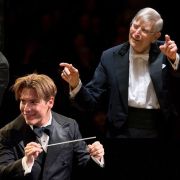
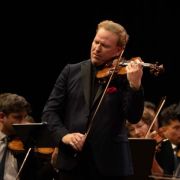
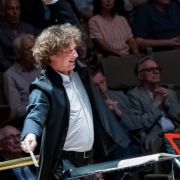
You don’t need gimmicks in Mahler’s First Symphony. You just need the best conductor and orchestra in the world. The aptly-nicknamed ‘Titan’ of a work was premiered (in its original version) in Budapest, so perhaps Iván Fischer and his Budapest Festival Orchestra, the dazzling Hungarian visitors to the Gstaad Menuhin Festival on Sunday, can feel justly proprietorial about it.

Full of fire and clarity, with intense, vibrant strings, eloquent woodwind, high-finesse brass and deep-dug foundations from the double basses along the back, the BFO is always a joy to hear. The creative acuity of Fischer, who founded the orchestra back in 1983, fuses entirely with his performers’ trust (if you need proof, just watch the front desk of the cellos). They climbed Mahler’s mountains as if roped together.


Fischer treated the symphony as a giant, visionary tone poem, the concepts sharply focused, the characterisations so well mixed that you could nearly taste them. The restrained tempo for much of the first movement was perfect for relishing Mahler’s “schöne Welt” (the music is shared with his Lieder eines fahrenden Gesellen). The second movement’s central Ländler section had marvellously lingering, teasing rubato, and the funeral march’s Klezmer episodes bristled with high energy and black humour; beneath, there lurked the Weltschmerz – or something darker – that haunts the fadeout. From there, the finale rose up as an overwhelming testament to resilience and resurgence. I hesitate to use the word ‘mindblowing’, but it does fit the experience.

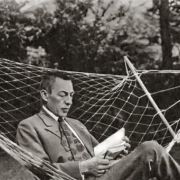
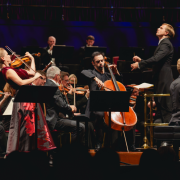
First, though, Rachmaninov. The BFO loves creative twists, and this time a row of its violinists serenaded us at floor level with a seductive account of the Vocalise before the British pianist Isata Kanneh-Mason arrived as soloist in the Piano Concerto no. 3 in D minor. This most virtuosic and exposed of concertos proved that Kanneh-Mason, the eldest of her seven-strong musical siblings, is at the top of her game. She seemed scarcely to break a sweat while making the necessary stamina and meteor-showers of notes her own. Her full, rich sound never splashes or harshens, and she integrated seamlessly with the orchestra and Fischer. Indeed, integrity seemed her watchword: there is a refreshing lack of nonsense about her playing, devoid of any tendency to be ‘performative’. She simply directs all her energy into the task in hand. Rachmaninov, famously a restrained, cool-headed performer, might have approved.


And that problematic tent acoustic? The BFO’s magnificence blasted straight through it. All in all, this was an exhilarating, unforgettable evening of music at everyone’s peak.
Jessica's press trip was funded by the Menuhin Festival Gstaad