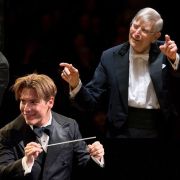
The second “Großes Konzert” of the Gewandhausorchester’s season was supposed to see the return of former Gewandhauskapellmeister Herbert Blomstedt. Ill-health prevented the 99-year-old maestro from appearing. His replacement to conduct Bruckner’s mighty Eighth Symphony was Marek Janowski, a mere 87 years old and most recently chief conductor of the Dresden Philharmonic not far down the road.

Janowski has announced his retirement from conducting at the end of this year, but there was no sense of this being a “late”, valedictory interpretation. It was a performance that in many ways reflected the conductor’s no-nonsense podium manner. He does what we’ve always learnt conductors do: the baton in his right hand marks the beat; his left adds expression; there’s not the slightest hint of histrionics or showmanship. The programme advertised the running time as 85 minutes, and that’s exactly how long it took.


But, as we launched into the opening Allegro moderato, the benefits of the conductor’s clear-sighted approach became immediately clear: this was to be Bruckner defined by an exciting sense of urgency, an instinctive musicality and an almost classical sense of coherence, with the composer’s harmonies built from a robust bass line-up. And it was to feature playing from the Gewandhausorchester of the highest quality, the singing cellos and superbly sensitive solo horn especially memorable. Only occasionally did the brass risk upsetting the impeccably balanced overall sound at the climaxes.
The Scherzo buzzed along furiously (not much regard for the moderato of the allegro moderato marking here) and the orchestra responded with thrilling virtuosity before relaxing into generous lyricism in the Trio, where Janowski’s control of legato on the level of both phrase and paragraph was especially impressive.
The Adagio opened with a rich earthiness to the lower strings’ chords, out of which the violins’ tentative melody – phrased with aching beauty – was allowed to grow as if organically. The music unfurled with a powerful sense of inevitability, never dragging (as Bruckner decrees) but never rushed. The build-up to the final climax was superbly managed; only at the final iteration of the upper strings’ harp-gilded chords did I miss the extra time that some conductors allow themselves.


We launched into the massive finale with a superbly taut, dramatic account of the opening – those galloping Cossacks in the strings highly disciplined, the grand brass fanfares imposingly weighty. Janowski once again showed his mastery in drawing together the movement’s episodic strands into a coherent whole, while the opening idea was even more thrilling the second time round, the build-up to the final peroration as moving as it should be.
Did Janowski’s refined approach preclude some of the darkness, some of the elemental drama that this work – once dubbed the “Apocalyptic” – can offer? Perhaps, but few conductors today could match the sheer musical intelligence and coherence of his vision. And while he’s scheduled to conduct it again with the Berliner Philharmoniker in December, just days before hanging up his baton for good, I can’t imagine even them surpassing the Gewandhausorchester in terms of refinement and balance.