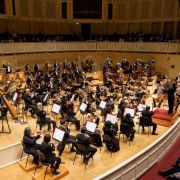
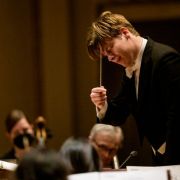
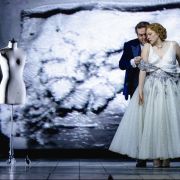
The Lyric Opera of Chicago has long striven to extend its reach beyond the mostly white audience that has traditionally formed its base. In a city whose white, black and Hispanic populations number close to equal thirds, outreach of this sort makes good sense both for attracting audience and donors and for reflecting the city it works in. El último sueño de Frida y Diego (The Last Dream of Frida and Diego) marks its most successful such foray to date, due largely to the strength of the opera itself.

The opera, with a libretto by Nilo Cruz and music by Gabriela Lena Frank, is about the 20th-century Mexican artists Frida Kahlo and Diego Rivera. The opera begins with Diego at a cemetery, visiting Frida’s grave and wishing for her return. In the underworld, various shades are offered tickets to return temporarily to the world of the living on Día de Muertos. Frida initially turns down the opportunity, remembering her life of physical and emotional anguish, citing the real-life Frida’s famous quotation that she had two accidents in her life, one when her body was shattered in a trolley crash and one when she met Diego. Just before intermission, she agrees to visit the world of the living. In the second act, Frida and Diego reunite, but when it comes time for her to return to the world of the dead, he begs to go with her. The Aztec god of the dead appears, and Frida and Diego go to the underworld together.


Frank’s music has wonderful, novel textures, and she is not afraid of repetition, giving the audience long passages to grow used to breathing string cluster chords or waterfalling harp. There is virtually always something interesting happening in the orchestration and the vocal lines fit the Spanish beautifully.

Cruz’s libretto has some oddities, but serves its purpose and runs at a pleasantly pensive operatic speed. He paints Frida the character with many similarities to Kahlo the real-life artist, including a willfulness and passion. However, he chooses not to foreground Frida and Diego’s tempestuous relationship – in life, they married, divorced and remarried, and both engaged in infidelities – instead having them talk about it, not show it. He also invents the idea that Frida, famously disabled in life, is uninjured in death until she contravenes the no-touching-the-living rule to embrace Diego. Cruz’s Frida has a heroic gloss over her at odds with the very qualities that define her as an icon.

Jorge Ballina’s set design impressively opposes an orange color for the world of the dead, evoking the marigolds traditional to Día de Muertos, with the blue of the walls of the Casa Azul, the house where Frida and Diego lived in Mexico City. Surprisingly little of Kahlo’s imagery appears onstage, with the exception of a second-half tableau of many Fridas posing in picture frames. In a note in the program, the director, Lorena Maza, asserts that she was avoiding “literal reconstructions, folkloric clichés and overexposed imagery” – a worthy goal to make the visuals stand on their own, but perhaps a bit misguided when the subject is one of the 20th-century’s most beloved visual artists.
To gauge at least from the main-floor audience and eavesdropping on the chatter at intermission, programming Sueño succeeded in drawing native Spanish speakers. The Lyric signaled its welcome to Spanish speakers by broadcasting its welcome-and-turn-off-your-cell-phone announcement first in Spanish, as read by Ana María Martínez (who sang the role of the Keeper of the Dead), and then second in English, read by Daniela Mack (Frida).


Less welcoming, though, were the supertitles projected in English only. Mainstage operas at Lyric use English supertitles exclusively, regardless of the language being sung. (There are no seat-back screens offering other languages.) Some muttering during the performance occasionally indicated that Spanish titles would have been welcome, even though the diction of the singers was exemplary, although Daniela Mack did let her Argentinean accent slip through at least once.
It’s good to feel like opera isn’t exclusively a 19th-century European art form. It’s also good to hear Spanish onstage, for only the second time ever in a main-stage production at the Lyric. It would be great to be able to rave unreservedly about both the production and the experience for the native Spanish speakers in the audience, but that still lies in the realm of the sueño.