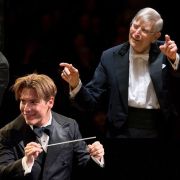
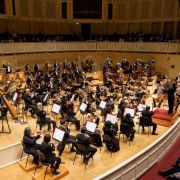
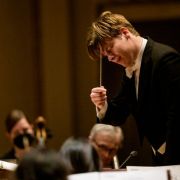
Sometimes the things you don’t notice are, upon reflection, the most impressive of all. Impressive and subtle details teemed throughout this stupendous concert by the Chicago Symphony Orchestra led by guest conductor Edward Gardner, currently on a US guesting tour. The program consisted of Samuel Barber’s First Essay for Orchestra as a curtain-raiser, Peter Lieberson’s Neruda Songs with mezzo-soprano Joyce DiDonato, and William Walton’s First Symphony. The Lieberson – DiDonato in particular – was stunning.

Currently serving as the CSO’s artist in residence, DiDonato projected the texts of the five sonnets by the Chilean poet Pablo Neruda with a kaleidoscope of emotions, never letting her passionate flourishes turn mawkish or stagy. She made the repetitions of words or lines that Lieberson drops into the score particularly poignant, such as “bienamada” (beloved), offered with a caress, and “no estés lejos de mí” (do not be far from me), with a keening melancholy.


Her delivery, too, was spellbinding. Slow, elegant arm gestures and gentle leans into emphasized words coupled with a striking look, with her blond quiff and a black dress with a spangly flower stitched into it. DiDonato’s supple, warm voice fit Lieberson’s choice of texts and emotions like a dream resting in a dream, as Neruda puts it in Sonnet 81. Her timbre and vibrato never strayed to overwrought levels, yet she did not have to strain to be heard, even with full orchestral backing.

That’s where the easy mastery of Gardner’s conducting became manifest. In the fourth movement, an instrumental interlude swelled the orchestra to a louder dynamic than it had previously played under DiDonato. All along in the Lieberson, the orchestra had been operating within a straitened dynamic range so as not to cover DiDonato, the contrast detectable now during her extended rest. The players had had plenty of room to maneuver even in the narrower band, but it hadn’t been noticeable that they were playing with any limitation at all.
Similarly Gardner seemed in command of subtleties in the works that bookended the Lieberson. The Barber ranged from the counterpoint of warm strings that opened it to growling piano and double basses to a dread-filled sense of approaching menace; all smooth transitions and showing, not telling.


The Walton symphony – not a piece heard frequently in Chicago – showed an orchestra fully in tune with the conductor. The first movement resolved into a big major-key finish that spurred applause, the second, skittering and nervy; the third, driven by the woodwinds, moved so gently from soft to loud that it was like a continual surprise. The finale had the maestoso quality of golden-era film scores. The symphony spent so much time in ending – shades of Dudley Moore’s Beethoven parody – that members of the audience chuckled a bit at the bombast, even as Gardner presented it with the driest humor.
And who knows what other careful, unnoticed brilliancies Gardner seasoned into the music? Even without knowing the full gamut, the finished product left plenty to be impressed by.