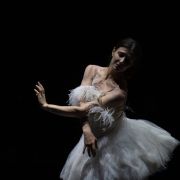
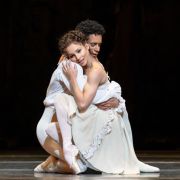
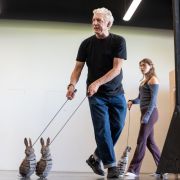
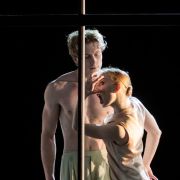
The final premiere of Opera Ballet Vlaanderen’s dance season was a bold triple bill collectively titled Love & Loss, the first two works already in the realms of ‘classics’ and the final piece, a world premiere. While it could have been deemed melancholic, at times dark and sombre, there was much joy too.

It opened with Anne Teresa De Keersmaeker’s 2017 Mitten war im Leben sind/Zweite Cellosuite in d-Moll. Originally created for her company Rosas, De Keersmaeker is methodical, geometrical in her creation of steps. It starts with the two dancers, Philipe Lens and Lateef Williams, sticking down gaffer tape to outline an axis upon which the thread of choreography will develop.
At this performance, Williams had the lion's share of solo dancing but I understand they alternate the roles. Key to the movement is Bach’s music and the fact that the cellist (Maria Franz) is placed on stage, not audience facing as one might expect, but facing the dancer. The music feels entirely integral to the dance. De Keersmaeker claims “My walking is my dancing” and so it was. Williams ran, walked and danced echoing Bach’s many changes in tempi and mood, mapping out the choreography in exceptional detail, emotional changes flooding over him in perfect alignment with Franz’s exquisite playing.


After a brief pause, the evening continued with William Forsythe’s Quintett (1993). Choreographed as a final offering to his wife, Tracy-Kai Maier, who died of cancer in 1994, it is an intensely emotional homage, made all the more poignant by Gavin Bryars’ music, Jesus’ Blood Never Failed Me Yet. In 1971, Bryars recorded an elderly, homeless man singing it in London and from there it grew. The excruciatingly repetitive nature of the music only served to highlight the sheer invention of the choreography.
The cast of five, Flavio Quisisana replacing an injured Austin Meiteen, Louiza Avraam, Lens again, Allison McGuire and Gaetano Signorelli each gave riveting performances. Forsythe’s choreography is never less than compelling but in Quintett he appears to have found a voice that resonates on many different levels. The overriding impression was one of complete trust. Lifts and partnerships moved and swapped swiftly. Weight changes proved surprising, outcomes unexpected. Bodies rolled across bodies, off balance extensions that seemed impossible to pull back from, suddenly swung back on balance.

Each of the dancers was completely invested and so were we. It could be described as an abstract piece but it was nevertheless keenly moving. Forsythe apparently describes his vocabulary as “ballet with disfocus”: classical technique with an element of uncertainty. Whatever it was on this occasion, it was astonishingly well delivered.
It was Canadian choreographers David Raymond and Tiffany Tregarthen who brought their world premiere and first creation for Opera Ballet Vlaanderen to the Antwerp stage. Only Light Years Away was certainly visually arresting. Starting with a loud foghorn, the pitch black stage was suddenly lit with searchlights. A lone dancer scuttled out from behind a mound. Hands and arms moved skittishly across the surface of said mound. It was slightly disconcerting and intriguing at the same time.


A dystopian land? Alien creatures? Yet the first really surprising moment was when a giant projection of a dancer’s pensive face appeared across the backdrop. A recurring theme, it felt as if we were being transported into the darkest recesses of the dancers’ minds. And it wasn’t entirely comfortable being there! It was though, tremendously effective stagecraft.
There were some interesting solos and duets (notably for Samantha Hines and Yannis Brissot) and towards the end some creative group work. Whenever Ausia Jones set foot on stage, her incredibly long limbs drew the eye. Sounds effects included running water and an open fire crackling away. Eventually there was a song/music of sorts but it has already faded from the memory. However, the most memorable aspect of the piece was the ever-changing projections, the light and shade and silhouetting of the dancers: the feeling that we were being invited to observe something not usually visible to the naked eye.

Eventually, I would like to see the movement language becoming more distinctive. This could be a case of working with the same set of dancers more regularly and bringing out their individuality but at the moment the phrases seem to comprise generic contemporary movement rather than strikingly original passages of choreography.
Deborah’s trip was funded by Opera Ballet Vlaanderen