How much mourning and basso lamento can one take, musically and emotionally, in a single evening? That was my thought as I stepped into Stone Nest for the final night of ‘Mourn’, a staged concert thematising grief that set Balkan and Black Sea traditions alongside Western Renaissance and Baroque ones. After two sold-out shows in April, Figure and Alkanna Graeca returned for another three nights in October, all of them sold out.

Fortunately, I didn’t have to worry. The programme of 14 pieces offered enough shades of sorrow, from the death of a young man to unrequited love and lost freedom, to keep you rapt. And it flowed astonishingly smoothly. Traditional songs from Georgia to the Adriatic, by way of Albania, Epirus and Thrace, morphed into madrigals, arias and laments by Lully, Gesualdo, Monteverdi, Cesti, Strozzi and Handel. Had the musicians tweaked some of the keys behind our backs? The performance also showed how naturally the so-called ‘West’ and ‘East’ share the vocabulary of lament.


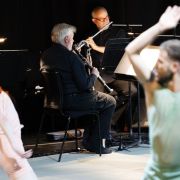
Props were few but effective: a chair, traditional dress, lace scarves, a pomegranate symbolising fertility, life and death. The stage action was equally compelling: two singers, eyes locked, bound by a red thread of fate wound around their fingers; a crossed-arm line dance, more poised than Tchaikovsky’s little swans; laundry scrubbed in a washtub during Strozzi’s Lagrime mie. Stone Nest’s balcony, stage and stalls were all used creatively, so you rarely noticed the next act being prepared. Edward Saunders’ spare lighting wasn’t solely for mood: at one point a singer faced the white spotlights, leaving only her silhouette. And the surtitles were a mercy.

Figure’s commitment was undeniable. Konstantinos Glynos’s kanun rippled with intricate fingerwork in Skaros from Epirus. Violinists Naomi Burrell and James Toll roved over Lully’s Passacaille from Armide with florid grace. Sergio Bucheli’s delicate plucking accompanied Lagrime mie. In the Albanian Janines c’i pane syte, eerie violin screeches and dry knocking added a sharper edge. Closely attuned to the singers, the ensemble ebbed and flowed as one, swelling to full resonance or receding into the background.
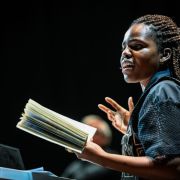
But at the heart of the evening were the singers: Alexandra Achillea, Irini Arabatzi and Dunja Botic. Their solos were stunning, their duets and trios tightly intertwined, with roaring forti and hushed piani. Botic’s lower register glowed in Monteverdi’s Lamento della ninfa, while Arabatzi’s controlled melismas soared through Cesti’s Disserratevi abissi. Achillea’s rendition of Lagrime mie almost brought me to tears. Most impressive was Epirotic Mor’ Deropolitissa, where the three joined forces for a gorgeously dissonant, meandering polyphony.


The evening was more than the sum of its individual parts: this grieving marathon was carefully planned and it paid off. The music worked such a spell that I missed Handel’s Lascia ch’io pianga turning into the final Drijema mi se, drijema, the instrumentalists singing along. Stone Nest – not too small, not too large – suited this intimate, tearful programme.