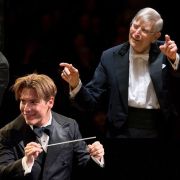
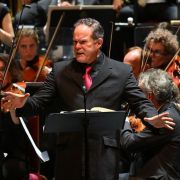
The resort city of Pärnu in southern Estonia was sadly waterlogged for the opening of its 16th annual festival, but musically at least a warm sun beamed down. Standing ovations are de rigueur here but it takes a special person to earn one before a note is played, and few would deny that Neeme Järvi, Estonia’s favourite musical son now in his 90th year, deserved it more than most. The fact that he proceeded to lead the young players of the Järvi Academy Symphony Orchestra through a challenging programme of Romantic delights, and did so with the tireless energy of a man half his age, confirmed that he still has what it takes.


The Pärnu Music Festival is a Järvi family affair (Neeme’s sons Paavo and Kristjan conduct later this week) and the repertoire is a blend of the familiar and rare. The Estonian composer Heino Eller (1887-1970) features strongly this year and his symphonic poems Dawn and Twilight (works unlinked beyond the temporal allusions in their titles) are honest, unpretentious offshoots of the Russian romantic tradition. The former is a plangent, rhapsodic piece with a stirring oboe solo whose harmonic language delighted the innocent ear despite its lack of thematic originality. The latter, in three short movements, paints greetings-card images in music, the hum of insects and the glow of fireflies there to add a sugar frosting to the effect. This is beautifully crafted music that gave pleasure through its immediacy and warmth.
The name of Czech composer Zdenĕk Fibich (1850-1900) is better known than that of Eller but his substantial symphonic poem At Twilight (no relation to the above), although just as appealing in its melodic structure, felt more studied, its romance more clinical, driven by the head more than the heart. Above all it lacked spontaneity. Rightly or otherwise, it sounded like the music of a man who has spent too long studying the formulae of his forebears.


Pärnu’s young musicians played all these unfamiliar works with professional confidence and savoir faire. They fed richly on the wisdom of the elder statesman who conducted them and delivered the evening’s better-known music with aplomb. Grieg’s Elegiac Melody no. 2, Last Spring, a piece whose wistful melody is better remembered than its prosaic title, was heartstopping in Järvi’s hands: aromatic and steeped in nostalgia.
Dvořák’s equally lyrical overture In Nature’s Realm emerged so sweetly and in such a finely structured reading that the youngsters playing it sounded like long-lived poets. As for Smetana’s eternal Vltava from Má vlast, it ran its course in ever-expanding vignettes of rivulets, streams and tributaries until, at the last, Järvi‘s orchestra sent shivers down spines when the composer’s estuary music burst into a glorious major-key climax as the river met the open sea.
Mark's press trip was funded by the Pärnu Music Festival