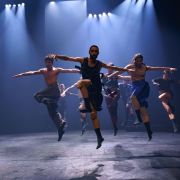
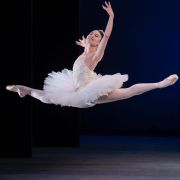
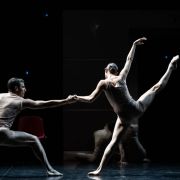
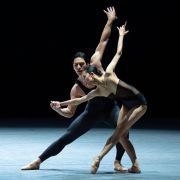
If art is a reflection of our times then we are in a dark place indeed. Nederlands Dans Theater opened its 2026-27 season with two works, The missing door (2013) by choreographer Gabriela Carrizo and a new work by Hofesh Shechter entitled Tunnel Vision. Both pieces transformed the stage at the Amare into dystopian spaces attracted to darkness. One immersed in a theatrical hellscape of the macabre, the other, a relentless motion of shifting tensions in search of healing.

Carrizo’s The missing door is, if anything, Creepy with a capital C. Nothing is as it seems in The missing door and that is precisely the point. The lights go up and immediately the audience is inundated with uncomfortable questions. Why are there so many doors? The set looks like the cross between the interior of a living room and the Bates motel from Psycho. A man on a chair and a woman laying on the ground seem to be dead but how? And why does someone who appears to be a kind of groundskeeper drag the woman from her feet out through a door and immediately starts cleaning the floor with a rag which becomes a devilish duet with an inanimate object?


Carrizo has the incredible ability to manipulate iconic cinematic tropes and transgress them – sometimes literally through the dancers’ insane physical capacities – heightening the eery tension that permeates the piece. The seven dancers are fully formed characters each with disparate intentions and compelling back stories. There’s a women in a french maid outfit who continually lingers against the walls of the set, eavesdropping on a couple who appear to be married (but who’s to say?) A man in a white tank top seems a shoe-in for ‘Stanley Kowalski’ and a man in a black suit directs the action centre stage by playing with various stage lights and follow spots. Somewhere between Kubrick, David Lynch and Hitchcock, the audience has a strange familiarity with the characters without being explicit, adding to the overall creepiness of what is taking place.

And what is taking place exactly? Carrizo boldly pushes the dancers to embody a theatrical world that no actor could possibly pull off. It's almost as though we the audience are looking at a piece of found footage enhanced by the soundscape composed by Raphaëlle Latini. There are audio sounds of equipment gone awry, buttons being pressed, glitches, scratches and skips all being physically enacted perfectly by the dance artists. Unbound by time, the characters moved in reverse, wriggled, convulsed and fidgeted, all confined in a place of purgatory. The cast who performed opening night was absolutely riveting. Bravo to Rui-Ting Yu and Alexander Andison for committing themselves to a truly outstanding pas de deux that left me speechless.
It's almost hard to believe that this piece was originally created 13 years ago. It’s definitely a season opener that will linger in my imagination, if not my nightmares (and that’s a good thing!).


Hofesh Shechter’s new work, Tunnel Vision, was a solid pairing for the evening in that it was also a work that seemed confined to a liminal space, perhaps in the mind of a singular dancer portrayed on opening night by Barry Gans. Those familiar with Shechter’s work will recognise the unmistakeable dance language of street and social dance rooted in classical technique. If anything, Tunnel Vision is a showcase of movement and stage design that has set the standard for contemporary dance in the last decade. Together, the talented dancers created various formations of undulating wave patterns sharply contrasted with moments of performative brutality and complex tableaux. The shifting dance scenes punctuated by light in various regions of the stage added to the overall disorienting feeling of the piece. While it was refreshing to see the dancers engage with classical music, the overall loudness and sound production was borderline unnerving in its dissonance.

There clear moments of meditation – the piece begins with Gans sitting in lotus position which becomes a recurring motif – which seemed to suggest that ‘out of stillness’ comes turbulent and divergent ideas that often meander. There were moments during Tunnel Vision, especially toward the end, where I felt was a bit distracted and I'm not sure that’s a good thing. Still, I thought Nicole Ward was exceptional, and her dance duet with Kele Roberson added a fresh movement quality to the overall piece.
The clear stand out of the night has to go to lighting designer Tom Visser who has been at the top of his game for decades. Visser’s ability to create and shape moods through stage lighting is truly unparalleled.