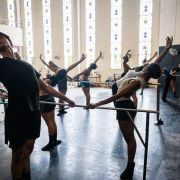
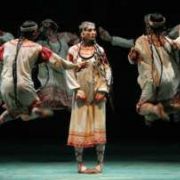
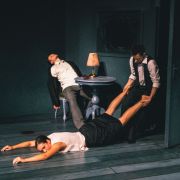
Dutch National Ballet opened its 2026-2027 season with a mixed programme of four pieces, showcasing the breadth the company’s talent and artistry. With Legacies, Artistic Director Ernst Meisner has successfully curated works that displayed the diversity and dynamism of the company.

The evening began with Symphony in C, a quintessential Balanchine ballet, using a sizeable portion of the company’s talent. The four movements, set to George Bizet’s Symphony in C, is each a masterclass with its own group of corps de ballet, soloists and principal couples.
While, Jessica Xuan gave the first movement an ethereal touch and Semyon Velichko was both steadfast and princely, I found the chemistry between Yuanyuan Zhang and Martin ten Kortenaar quite moving in the more measured tones of the second movement. Both Zhang and ten Kortenaar seemed very grounded in their partnerhship, relishing in the adagio movements of their pas de deux. The completion of a tricky combination – one that required a series of risky penchés, deep lunges, dips and complicated hand work – gave them a triumphant sense of accomplishment.


The third principal pairing of Maia Makhateli with new soloist Siphesihle November only strengthened my conviction that Makhateli can truly dance with anyone. Dynamic and daring, she confidently radiated in this new partnership. Not to be outdone, November matched her energy with his sensitive musicality and weightless ballon. In the ballet’s final fourth movement, Chloë Réveillon sparkled and Vsevolod Maievskyi took to the stage with a joyful exuberance.

Balanchine always made sure to let the corps de ballet shine in his works. The tall women in the first movement seemed a bit self-conscious but became more expressive in the ballet’s finale. The shorter women in the second movement had more nuance, particularly in their port de bras. Overall, Symphony in C is one of Balanchine’s crowd-pleasers and Dutch National did not disappoint.
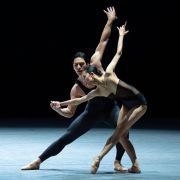
The second work of the evening was Simple Things by Hans van Manen. Initially created on NDT 2, the work created for two men and two women has all the recognisable movement quality that makes van Manen so touching and human. Van Manen’s love of ballet in combination with social dance (particularly the tango), his whimsical musicality, movement centred low to the ground and spirited footwork are all at play.

The duet danced by Edo Wijnen and Joseph Massarelli which both begins and ends Simple Things had a boisterous energy of two boys in a bubbly bromance. I’m always happy to see Wijnen onstage, especially when performing van Manen. He’s the kind of dancer akin to Gene Kelly. Not fussy but precise and oozing with effortless charisma. Massarelli also has the same dance presence and together both he and Wijnen sliced through the stage with a healthy dose of whimsy. The stirring duets Wijnen and Massarelli danced respectively with Riho Sakamoto and Maia Makhateli gave the work a sense of gravitas.
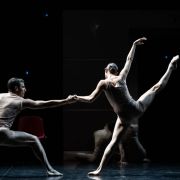
Canadian choreographer, Kirsten Wicklund premiered Monumento. The new work is danced to music by Dutch composer Willem Jeths whose composition Monument to a Universal Marriage was created in response to the legalisation of same-sex marriage in the Netherlands in 2001. Created on five dancers, Monumento seemed a bit of an anomaly in the evening’s programming, however it gave the audience a clear sense of where ballet could be heading in the future. Koko Bamford and Yuanyuan Zhang were captivating in their opening duo, challenging each other in interesting configurations sometimes reminiscent of winged creatures. Conor Walmsely was an alluring figure alongside ten Kortenaar and November. At times it felt as though the dancers, sometimes in same-sex pairings, trios or gendered duets were flecks of star dust moving through a liminal space.


Kudos to Tatyana van Walsum for creating such a striking costume design. The asymmetrical, off-the-shoulder, flesh-toned unitards glistened under Wijnand van der Horst’s lighting, accentuating the dancers’ muscular physique with a kind of alien aesthetic.
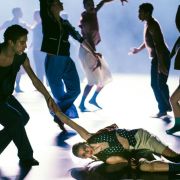
What I liked about Toer van Schayk’s Requiem, and what I found most impressive was its scale. Much like Symphony in C, van Schayk’s work had an incredible amount of dancers onstage and I appreciated the kind of democratic, almost non-hierarchical movement structure it had. Yes, I enjoyed Young Gyu Choi’s presence, Giorgi Potskhishvili’s bravado and Salome Leverashvili’s magnetism, but I was also taken by both Khayla Fitzpatrick’s movement sensibility and corps de ballet member Sven de Wilde’s stage presence. Kira Hilli anchored the work with her dramatic flair. This was the longest piece of the night, with a maximalist, didactic approach which is not really my thing. However, the dancers gave the work the respect it deserved.