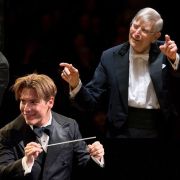
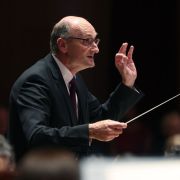
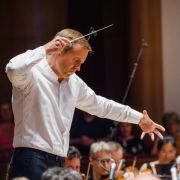
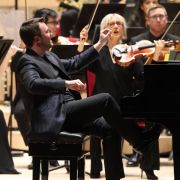
It's not very often that the premiere of a new piece – a UK premiere in this case – attracts anything more than polite applause and the knowing glance that says 'at least that's over'. But once Ksenija Sidorova and the Royal Liverpool Philharmonic Orchestra, under conductor Andris Poga, finished Dobrinka Tabakova's Accordion Concerto the hall erupted into rapturous applause, cheers and a standing ovation. And rightly so. This was a piece at times intimate, soul-searching and wistful and yet it radiated a triumphant positivity which clearly delighted the performers and took the audience, quite possibly, by surprise.

A joint commission by the Royal Liverpool Philharmonic and colleagues at the Bodenseefestival, Stuttgart Philharminiker, Sofia Philharmonic and Dzintaru Koncertzale, the piece was first heard last May in Stuttgart. It is a culmination of the composer's fascination with the accordion, “a machine with a soul,” as Tabakova calls it. But what a soul. It's an instrument which is so much part of European folk culture yet, in her visionary work, has become a symbol of our particularly troubled times. Tabakova has taken tradition along new paths and the expressiveness in this entire concerto takes the listener to a place which is sometimes uncomfortably fascinating but always completely riveting. She's tried to examine the ways in which our lives are being dictated by unfamiliar algorithms, with AI threatening our ways of life – if not our very existence – and superimposed that onto something which seems, outwardly, completely familiar. Maybe that is exactly what AI is doing to all our lives. Who knows?


The work's three movements use the accordion to great effect: its deep and powerful breath in Burning Ground, aspects of intimacy in the central Whispered Memory and an insistent Balkan-inspired dance in Ancient Patterns. These all allowed Sidorova to coax a mesmerising variety of sounds and timbres from her accordion and for the large orchestra to respond with total sensitivity and empathy.
An expansive opening began with an incredibly sensitive tremolando, building into a moto perpetuo which Poga did not allow to flag for a second. The soul-searching chorale in the second movement introduced a latter-day Chaconne, peppered with the highly effective percussion elements. The finale was a gigantic, exciting crescendo, reliant on some brilliant percussion playing. Add to that Sidorova's sparkling encore – Albeniz's Asturias – and anyone doubting that the accordion can interpret classical repertoire can forget that notion entirely.

There were, perhaps, almost sacrilegious thoughts about the rest of the programme. Would Rachmaninov's Third Symphony be an anticlimax after the high point of that premiere? Impossible, of course, as Poga and the RLPO proved with a highly driven performance. There was considerable vivaciousness in the finale where Poga constantly pushed the tempo along with some sublime solos from the horn and violin in the Adagio section of the middle movement. From the yearning insistence of the first movement which, in many ways, felt quite restrained, this was a competent, well-paced performance.


Add to that the comedy and irreverence of Prokofiev's Suite from The Love for Three Oranges, with all the verve and humour brought out by the conductor. The breathless Flight, where the brass simply played a blinder, the menacing string tones to accompany the Magician and the Witch playing cards and delicacy counterbalancing fortissimo outbursts, this was a great appetiser for an unusual evening of orchestral virtuosity and an ear-opening adventure.