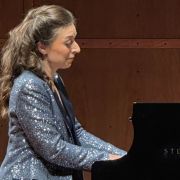
The self-effacing persona Seong-Jin Cho projected from the Benaroya Hall stage throughout his solo recital stood in striking contrast to his musical confidence – a confidence grounded not only in extraordinary technical security but in an evident willingness to take risks. Cho’s sense of interpretive freedom made itself felt from the outset, in a program that invited close attention and repaid it generously.

Cho’s playing is highly individual, marked by sudden shifts between inward focus and a kind of delirious playfulness, but above all by a fascination with sound itself – its variable weights, colors and rhythmic inflections. At times, he seems absorbed in timbre for its own sake; at others, acutely aware of dramatic effect. His gestures have been described by some as overly fussy in their micro-management; here, however, they registered less as mannered intervention than as a palpable pleasure in discovery.


That degree of attentiveness can occasionally invite a sense of micro-management, even a hint of mannerism, though here it rarely obscured the larger musical arc. The hall was packed with a visibly engaged audience, which responded keenly to this balance between spontaneity and control.
For the first half of the program, Cho selected three markedly different works in which a shared thread of engagement with nature or elemental experience could be heard. In Liszt’s 1877 Les jeux d’eaux à la Villa d’Este, he brought out a sense of joyful wonder at the beauty of the created world, revealing the piece as more than surface brilliance and already pointing toward the watery sound world Maurice Ravel would later elaborate. Cascades of notes were grounded in finely gauged touch and color. Cho lingered in the softer spectrum, allowing a subdued but persistent ecstasy to take hold – sensuous yet almost mystical.
A sense of open wonder carried over into his account of Beethoven’s “Pastoral” Sonata in D major, Op. 28. The steady bass pulse at the opening – often likened to a timpani beat – settled in calmly, unforced and spacious, as though the music were taking its bearings, while the staccato bass line in the Andante introduced a curious element of suspense. In the Scherzo, he placed tones as bell-like objects in space, while the bass again played a framing role in the finale, its evocation of a bagpipe drone introducing a note of ironic naïveté offset by the music’s adventurous contrasts.
Juxtaposed against the lyrical playfulness Cho brought to both Liszt and Beethoven, the percussive pianism of Bartók’s Out of Doors struck with raw, blunt force. In the opening Avec des tambours, the keyboard became a battery of drums, with the Steinway’s bass supplying plenty of sinew. Bagpipe-adjacent sonorities play a role in the suite as well, but Cho’s most compelling playing came in the spellbinding night music, where he proved meticulously alert to each strand of the sonic fabric, exploiting suspenseful moments of silence to unsettling effect.


Cho devoted the second half of his recital to 14 Chopin Waltzes, ordered into a sequence of his own design. This repertoire has been closely associated with him since his victory at the 2015 International Chopin Piano Competition, and his approach was unmistakably personal. In the D flat major “Minute” Waltz, for example, the dance registered only faintly beneath a whirl of color. Moving through shifting states of memory and character, Cho continually reimagined the waltz itself, at times nearly disguising and sublimating its physicality through subtle displacements and a remarkable elasticity of tempo.
Fractional pauses lent repeated ideas fresh expressive weight, while wisps of melody and harmony returned elsewhere like pale afterimages. Cho moved easily between soulful intimacy and playfulness, sustaining a sense of freedom that remained vivid to the end.