Richard Strauss’ Daphne is among the works most plausibly suited to Seattle Opera’s recent turn toward including concert performances as part of its main-stage season. Written late in the composer’s career, Daphne belongs to the turbulent political and cultural climate of 1930s Germany. The opera takes the form of what its librettist Joseph Gregor called a one-act “bucolic tragedy”, a design that often feels closer to an oratorio – or even a symphonic tone poem with voices – than to conventional music drama.

Gregor’s libretto braids together Ovid’s account of the myth in Metamorphoses with borrowings from Euripides’ ancient tragedy The Bacchae. The young, virginal Daphne is marked by a rural innocence that sets her apart from the predictable desires of the human community around her. She recoils from communal festivity, rejects the love of her childhood friend Leukippos, and is briefly stirred by the attentions of an interloper who proves to be Apollo in disguise. When the god is compelled to reveal himself, the divine force he unleashes strikes down Leukippos. Daphne’s resulting grief deepens her longing to abandon the human realm altogether. The opera ends with her metamorphosis into a laurel tree, absorbed into the nature she reveres.


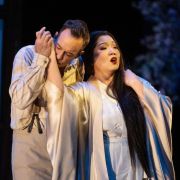
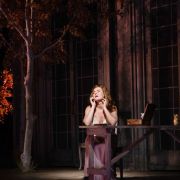
In her role debut, Heidi Stober portrayed a youthful Daphne whose innocence is tempered by an awareness of her own strangeness within her community. Moments of wonder and awakening desire registered in her ardent, Tristan-inflected duet with Apollo, before confusion and aversion set in. Vocally, Stober navigated the role’s punishing demands with impressive flexibility, shaping phrases and silvery high notes with imagination. In the final moments of her transformation, as Daphne relinquishes human language for fragmentary syllables, her singing suggested rapturous release.

As Apollo, David Butt Philip retained focus and intensity even at the score’s most precarious heights. His instrument – heroic in color yet high-lying – matched the role’s daunting tessitura. He was especially compelling in Apollo’s remorse after Leukippos’ death, the god’s overwhelming power suddenly refracted through genuine anguish. The stamina required here is formidable, matched in a different way by Miles Mykkanen as Leukippos, another of Strauss’ rare high-tenor creations. Mykkanen shaped the role’s lyrical writing with ardor, allowing flashes of Dionysian frenzy to break through the music’s pastoral surface.
As Daphne’s parents – Gaea and Peneios, who hover between the human and the elemental – Melody Wilson and Matthew Rose inhabited low-lying roles that lent the drama a darker, weightier sonority, counterbalancing Strauss’ vertiginous upper-register writing for Daphne and the two tenors. Wilson projected Gaea’s presence as a maternal oracle, solemn and Erda-like, her vocal roots reaching toward emotional truths that Daphne is not yet equipped to understand, even if the very lowest notes were not always fully secure. Rose supplied steely gravitas as Peneios, with a gravelly bass that anchored the familial and mythic dimensions of the drama.
The two Maids, sung by Meryl Dominguez and Sarah Coit, contributed delicately entwined lines that evoked distant echoes of Rhinemaidens and Flowermaidens, nostalgic figures in a score shadowed by the composer’s anxieties about Germany’s cultural legacy. A small group of shepherds opened the opera energetically, though some lines were occasionally covered by the orchestra.


Although David Gately was credited as stage director, the dramaturgical contribution was understated. In an opera whose episodic structure – and occasional longueurs – can feel opaque even when fully staged, clearer visual cues signaling the transitions between scenes would have been helpful. Singers were largely tethered to their music stands, understandably given the work’s rarity and difficulty, but limiting in dramatic terms. More effective was Ranleigh Starling’s lighting design, which used abstract color projections to articulate shifting moods, such as fiery solar hues during Apollo’s revelation of his true status.
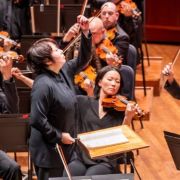
With the orchestra placed prominently onstage – augmented by additional players to meet Strauss’ demands – the setup placed heightened emphasis on the musical execution under David Afkham. After a somewhat tentative opening scene, his ear for texture and balance asserted itself, lending the score Apollonian transparency while allowing Strauss’ surging, Dionysian energy to register without overwhelming the singers. Tendril-like woodwinds traced the pastoral opening, while the transformation scene unfolded over a densely iridescent web of strings, as Daphne, in a kind of pantheistic Liebestod, sang herself into ecstatic stillness. The Seattle Symphony musicians responded with refinement and character, with the all-male chorus, beautifully prepared by Michaella Calzaretta, adding a distinct layer of color to the sound world.
As the transformation proceeded, to music Strauss himself memorably described as “Magic Fire music with different notes”, green light spilled outward from the stage, extending the image into the audience and drawing it into a kind of Straussian rite of spring.