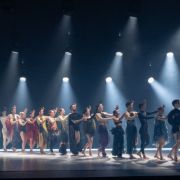
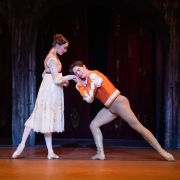
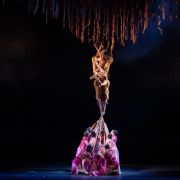
Bangarra Dance Theatre’s latest triple bill looks both forward and back, pairing two works from the company’s Dance Clan initiative for emerging choreographers with a revival of co-CEO Frances Rings’ 2015 Sheoak, a work that honours the company’s artistic lineage while speaking directly to the present.

The evening opens with Bangarra alumni Glory Tuohy-Daniell’s Keeping Grounded. The dancers appear dressed plainly in white singlets and loose, sand-toned cargo pants (costumes by Claire Parker). They read as clean and grounded and connect beautifully with the set, which is an enormous fishing net suspended across the stage; bodies emerge and disappear into it, functioning as both playground and trap. The lighting (Karen Norris) throws an orange sheen across the stage. The movement language is a mix of fluid and angular, with robotic isolations and looping gestures giving way to moments of release; dancers recline with their legs crossed in the air, then pull one limb back like cocking a gun.


A standout duet between Daniel Mateo and Roxie Syron finds extraordinary complexity and athleticism in acts of support and counterbalance, including Syron in a headstand and then wrapped in flexion around Mateo’s torso while they whirlpool diagonally. Mateo has already been flagged as a dancer to watch, and I think Syron deserves entry into that club: she’s a punchy, pocket-rocket of dancer who can turn on a pinhead from fierce to fluid and back again. Throughout, the work repeatedly returns to images of earth, stillness, and the intelligence of the body – backed by Brendan Boney’s pulsing score.

Daniel Mateo’s Brown Boys, a 6-minute video piece with both movement and spoken verse (co-directed by Cass Mortimer Eipper), is focused on masculinity, race, vulnerability and belonging. Mateo envelops himself in a traditional mat (fala), while being blasted with sunlight and earth: dirt and honey and brown boys who “stayed out late past our skin”. I first saw Brown Boys in 2024 when it premiered as part of Bangarra’s Dance Clan, in the Bangarra Theatre, a small and intimate space. Then, I described it as a cinematic love letter to the sun, ocean and the male body. Projected across a giant screen in the vast Joan Sutherland Theatre at Sydney Opera House, its imagery acquires even greater force.
The evening culminates in Frances Rings’ Sheoak, first created in 2015 in response to comments made by former Prime Minister Tony Abbott describing life in remote Aboriginal communities as a “lifestyle choice” due to perceived government limits around the cost of funding such communities. Rather than offering a direct political argument, Rings responds through imagery of resilience, cultural dignity and collective strength.

The dancers wear costumes by the inimitable Jennifer Irwin, patterned with skeletal motifs and painted with ash-white ochre that blurs the boundaries between flesh, landscape and spirit. Pools of overhead light create a ritual atmosphere. Sticks descend from above and plant on either side of the stage like the ribs of a vast whale skeleton. Dancers thread between them with precision and ferocity. Men wrestle, shove and compete before collapsing into moments of reconciliation and care. Throughout, Rings balances rough physicality with surprising tenderness. Combined with Karen Norris’s atmospheric lighting and David Page’s evocative score, the effect feels at once intimate and powerful.


The final images are among the evening’s most memorable. Kallum Goologong enters wrapped in a long textured ceremonial peach garment around his lower body, his torso bare but for white ochre. Bent forward at the waist, his shoulders and arms ripple and coil with extraordinary detail. It is classic Bangarra movement: sumptuous, grounded and powerful. Translucent sheets billow across the stage with ghostly figures behind them, dissolving into softer, luminous visions of survival and renewal. Accompanied by Page’s score, Sheoak becomes both memorial and celebration.

Taken together, the three works demonstrate Bangarra’s continuing ability to nurture new voices while remaining connected to its cultural and artistic foundations. The result is an evening concerned less with shelter as refuge than with something actively built and maintained through community, memory and movement. Bangarra has only recently moved to performing at the Opera House. Sheltering, with a much-deserved standing ovation, feels like coming home.