Mother Nature must have read the love letter BalletX sent her on Thursday evening.

That’s how the company describes The Four Seasons Reimagined, its latest world premiere. It was a stunning tribute to the natural world, and the elements promptly returned the affection. The outdoor Highmark Mann Pavilion enjoyed perfect weather, enhanced by an immersive touch of magic: butterflies floating through the air and onstage, with the fresh scent of magnolia trees drifting across the arena on soft, warm winds. This unique performance did more than honor nature; it also celebrated the nation’s 250th anniversary of independence in its birthplace, Philadelphia.
A program note cites scientific evidence that, “by mid-century, the average temperature in Pennsylvania is expected to increase by 6.7 °F. … heat waves will become more frequent and more intense. It will rain less frequently, but when it does, it will pour… the seasons that have for centuries ordered our lives are being altered… we cannot control the world, but we can choose how we move through its seasons… The next phase of this grand American experiment will test our values, ideals and infrastructure.”


Artistic Director Christine Cox assembled four choreographers and composer Dan Deacon, who reimagined Antonio Vivaldi’s music for the modern era, leaving echoes of the 300-year-old composition. To the classical strings, Deacon added jazz trumpet, pedal steel, saxophone and a trombone, reflecting how our times and seasons have changed. Deacon and an eight-musician ensemble played live from the pit.
Beginning with Summer, choreographer Morgann Runacre-Temple constructed scenes for the 16-member ensemble that explored “what summer is today and what we have lost” as she explained in a pre-performance documentary by filmmaker Daniel Madoff. The dancers began in a circle of pairs, expanding and retracting like petals, before breaking off into a series of pas de deux and pas de quatres. A sense of urgency and uncertainty filled the piece as they explored each other's bodies, placing hands on chests and heads as if testing for certainty. One striking formation held two women atop a human pyramid, their hands resting on each other's heads, before the structure was split reluctantly by an invisible force. Dancers later formed smaller pyramids, as if acclimating to the changes.

Penny Saunders choreographed Autumn in the glorious colors of fall foliage: flowing, wide-leg pants and sharp-shouldered shirts of flaming red, vibrant orange, deep purple and earthen brown. In one remarkable pas de deux, two dancers executed lifts and turns using only their outstretched arms and grasped hands for stability — evoking branches inevitably shedding their leaves. Dancers barely swept the floor with their feet and hands before rolling into axle turns and forward-propelling motions, as if tossed by a sudden gust of wind. There was an overall sense of reflection and reckoning, as the dancers gathered together, only to be blown apart into singular pieces.
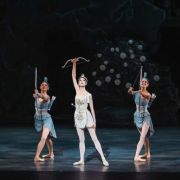
In Winter, choreographed by Jamar Roberts, dancers wore asymmetrical, icy-silver costumes, with the women performing on pointe (as they also did in Spring). They moved cautiously and intentionally, as if conserving energy, like a flock of birds in the snow. They fluttered their wing-shaped arms as if to shake off moisture and flew in V-formations. Arabesques were quickly retracted and bursts of flight suddenly halted, achieving moments of stillness, set to tinkling piano chords.


The finale, Trey McIntyre’s Spring, was wildly imaginative. At the start, technicolored dancers formed a tight cluster as they reached skyward toward a beaming light, their hands rapidly quivering like buzzing bee wings. The accompanying film portrayed bees pollinating flowers as a black air balloon floated over a valley, while a large, weighted black balloon drifted above the audience during pauses and intermission.
The dancers moved with determined, technical precision, embodying both pollinators and receptors themselves. In one sequence, a group formed a flower with a woman at its center shaped like a stigma; in another, three dancers held a woman upside down with her legs open, shaping a seed-like pod. Embodying both stamen and stigma, the dance teemed with sensuality and the potential of new life. As the music crescendoed, the dancers returned to their original cluster, arms extended eagerly with quivering hands as a burst of confetti rained down upon them.

The Four Seasons Reimagined served as an essential reminder of the cyclical nature of time, illustrating that no matter how dark a moment or decade may seem, a spring of rebirth and renewal will follow. Most importantly, the performance depicted that we are not separate from the natural world, but an intrinsic part of it; how we treat Mother Nature remains a direct reflection of how we treat ourselves and one another.