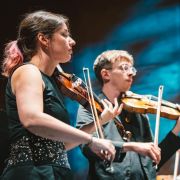
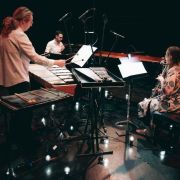
Nil Venditti is like a small, benign bomb exploding in the world of classical music. She owns a wonderfully precise delivery, an ability to charm audiences while still informing them, as well as a passion for music that you could almost touch. She dances on the podium but is also capable of moments of immense stillness. She calls the members of the Royal Northern Sinfonia her friends and this is evident not only from the intense concentration of the playing but also in the warmth of the smiles exchanged between players and conductor.


She gave a brief, illuminating introduction to Mendelssohn’ Scottish Symphony including the suggestion to listen out for Bar 25 in the finale: “this is where, if the conductor is too fast, the strings fall apart!”. The RNS conjured up Mendelssohn’s dark, moody images, inspired by the ruined chapel at Holyrood and the vagaries of the Scottish weather, with a chilling realism. Venditti has a particular gift for lighting up layers in the orchestral texture, such that a diminuendo in one section, for example, can meet a crescendo in another, to thrilling illustrative effect. As Bar 25 approached, she turned and gave a conspiratorial grin to the audience.
Before the interval, Maria Włoszczowska had made the technical demands of Prokofiev’s Violin Concerto no. 2 in G minor seem easy, soloist and conductor frequently seeming to dance together. The second movement was particularly atmospheric, ending as though the echo of an 18th-century waltz could just be heard floating on the breeze from an open window in the distance.
Despite the Stradivarius under her bow, Włoszczowska seemed unable always to adequately project the depth and intensity of sound that Prokofiev demands. I heard some audience members in the interval complaining that this had been due to over-enthusiastic amplification of the orchestra – if this is the case, it’s the first I’ve heard of it, enthusiastic or otherwise. It seems more likely to me that situated in the middle of the stalls as I was, the sound was simply projecting to higher levels of the auditorium, a rare example of the Glasshouse’s justly famed acoustic failing to deliver to every seat. Conductor and soloist negotiated the frequent changes in tempo and mood inherent in Prokofiev’s episodic and sometimes capricious work with intelligence and dignity. As an encore, Włoszczowska played the Largo from Bach’s Third Violin Sonata. Venditti sat cross-legged at the side of the stage, beaming with pleasure.


To start the concert, Anna Clyne’s Rewind was despatched with technical authority, although shorn as it was of its optional tape loop it seemed lacking in originality. The Chicago Classical Review described a recent performance as a “grand romp” and that just about sums it up.