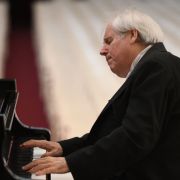
Even his appearance seemed to belong naturally to the music he was about to unfold. With ash-coloured hair worn loose and untamed, and a self-effacing poise at the fortepiano, Ronald Brautigam appeared in complete harmony with the refined 18th-century sound world that took shape on Sunday evening at the Muziekgebouw aan ’t IJ. Nothing in his presence felt theatrical; it suggested instead the quiet authority of an artist whose interpretative maturity had absorbed questions of style into a coherent musical language.

That same equilibrium informed the programme, shaped in close dialogue with conductor Michael Alexander Willens and the Kölner Akademie. Works by Johann Wilhelm Wilms and Louise Farrenc were placed alongside Beethoven not as curiosities, but as voices sharing a common aesthetic horizon, creating a journey where rediscovery and familiarity strengthened one another.


In the Piano Concerto in C major by Wilms, Brautigam asserted himself through careful articulation rather than sheer brilliance. He let the fortepiano’s lighter touch shape each phrase, favouring precision and nuance over weight. The passagework unfolded with purpose, never merely decorative, while the orchestra maintained transparent textures that allowed winds to respond with subtle wit and strings to provide support without thickening the sound.
Farrenc’s Symphony no. 1 in C minor revealed the ensemble’s cohesion and rhythmic alertness. Rooted in Classical discipline yet conscious of Beethoven’s looming presence, the composition balances rigorous structure with carefully restrained colour. Willens guided the orchestra with architectural control, the lower strings providing incisive energy and woodwinds adding warmth without excess. While the symphony did not offer immediately memorable themes, its inclusion was illuminating; the orchestra’s tailored sonority brought out the work’s substance, allowing the music to speak plainly.
Beethoven’s Piano Concerto no. 3 in C minor provided the evening’s emotional centre. Brautigam’s intelligence at the fortepiano was fully revealed here: the instrument yielded a tone rounded, firm yet never harsh. This dual character is precisely what the pianist ideally seeks in a fortepiano, an instrument that allows articulation and colour to shape the drama instead of relying on sheer mass. In the opening movement, tension grew from subtlety rather than volume, the dialogue with the orchestra unfolding with chamber-like responsiveness. The Largo sang with unaffected simplicity, while the final Rondo advanced with controlled urgency, its momentum taut yet never hurried.


The resounding applause that filled the hall said more than words could. It celebrated the shared effort of soloist, conductor and orchestra, moving together with rare unity. Amid this, Brautigam’s playing revealed the programme’s subtle balance: Wilms and Beethoven, different yet of the same period, were treated with equal care, letting the fortepiano’s ‘dual soul’ shine through.