To open its 50th season, Boston Lyric Opera made the bold decision to perform Rossini’s William Tell. Given their limited resources, they made the equally bold decision to trim the opera down to two and a half hours of music: repeats and dances eliminated, recitatives condensed or excised, and, in a few cases, whole scenes, like Act 2’s hunting chorus, jettisoned. Although some of BLO’s past productions have been weighed down by ungainly concepts, this one fired on all cylinders. All the trimming and condensing was in service to the staging. This production worked within the company’s means to create a memorable afternoon of theater.

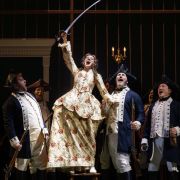
Vita Tzykun and David Allen Moore’s staging centers the violence and savagery implicit in the narrative. Gone are the more bucolic scenes which lighten the action. This might be the grimmest Tell you ever see, deepened by its grey unit set and dingy costuming for the Helvetians, but it pays dividends in the power it confers on the action.


The first scene sets the tone, beginning quietly over the overture’s galop. Downcast Helvetians are frisked and fingerprint scanned upon entering a room with a raised platform with a backdrop of an Alpine vista. Most are herded to one side by military goons wielding long riot sticks. Others are lined up on the platform and given bright blue coveralls to don over their rags. The presence of cameras soon makes it clear that this is staged propaganda. The chorus and Ruodi’s aria are the soundtrack. In the course of his aria, one of the goons taunts Ruodi and pulls his watch cap off unleashing his long lush locks. This triggers the goons and they begin to abuse and manhandle the boatmen so persistently and violently that each of Morgan Mastrangelo’s high notes becomes a scream of pain.

The production continues to land gut punches ranging from a mêlée between the people and Gessler’s thugs which leaves Melchtal dead and a woman violated to a roiling riot as the people curse Gessler then run amok, ransacking his chambers. The volatility and violence make the majestic sunburst of the final chorus well-earned. Further, leaving time and place vague frees the plot from the specificity of historical events while anchoring the action in a quintessential repressive, totalitarian regime.

Diction and French pronunciation were variable, but the singers more than fulfilled their roles. George Gagnidze dominated physically and vocally as a fearless, paternal leader, the depth and complexity of his character showing most in his encounters with Arnold. Cutting repeats relieved Konu Kim of several high Cs but those that remained were crystalline and true. He attacked and held the last on the word “armes” with panache. In addition, Kim also displayed a honeyed mezza voce and silken legato.


Anya Matanovič has appeared with the company before, so the fact that she seemed to have trouble at times maintaining consistent volume throughout her range suggested an indisposition. Otherwise, she was a lyrical Mathilde in her aria and duet with Arnold and a defiant spitfire in her challenging Gessler in Act 3. Since a light soprano usually plays Jemmy, the production team decided to just make the character Tell’s daughter. However, Brianna J Robinson has a mature, powerful voice which made Jemmy sound much older and closer to her father in power and stature.

Hunter Enoch and Yeghishe Manucharyan as Gessler and Rudolph so embodied power-hungry sadism they more than earned their gruesome ends The remaining cast members were these characters’ equals vocally and dramatically and all benefited from David Angus and the orchestra’s spirited and supportive playing. The final chorus can’t fail to lift the audience out of their seats and flood the theater with light if properly calibrated and built to fortissimo, as it was here. And it’s no accident that, when the curtain rose for curtain calls, it revealed the chorus, the backbone of this performance.

Purists might be appalled, but Rossini himself might have been much less perturbed by such a production. When a guest remarked he had recently heard Guillaume Tell, the composer mischievously asked, “All of it?” He knew his swan song presented production challenges. Even during its opening run cuts and changes were being made. Other theaters tailored their own in order to meet the opera’s daunting requirements. Like any man of the theater, Rossini’s primary concern would have been, does it play? The answer in Boston was a resounding yes.