American composers’ treatments of Abraham Lincoln seem prone to courting political controversy. Aaron Copland’s 1942 Lincoln Portrait was dropped from Dwight Eisenhower’s Inaugural Concert in 1953 after a McCarthyite congressman from Illinois (ironically Lincoln’s hometown) deemed the composer’s left-wing politics a disqualifying factor. Fast forward to this year, when Philip Glass’ Symphony no. 15, “Lincoln” was scheduled to premiere at the Kennedy Center, Washington DC. Intended to mark the Center’s 50th anniversary in 2022, it was not completed in time so ended up becoming embroiled in Donald Trump’s coup des arts. Glass withdrew the belated premiere in January, stating the values of the Kennedy Center as currently constituted conflicted with those he was seeking to express.


Shortly thereafter, the Boston Symphony announced it would host the premiere at Tanglewood on 4th July weekend with longtime Glass collaborator, Karen Kamensek, conducting. Copland’s Lincoln Portrait and John Williams’ film-score suite, Music from Lincoln, were added to complete an all-Lincoln program.
Though Glass calls Lincoln a symphony, it plays more like a secular oratorio with each of its eight sections fairly self contained. Some precipitous transitions and cut-offs contributed to this episodic quality. The same arpeggiated pulses in the strings and counter rhythms in the percussion which begin the symphony recur in the final section, Farewell. Little else seems to tie the sections together, however, although repeated listening may reveal what was not immediately apparent at first.
Extended excerpts from the 28-year-old Lincoln’s 1838 Lyceum Speech comprised the first two sections. An orchestral interlude led into the fifth and sixth sections’ autobiographical snippets with their homespun self-deprecation followed by Slavery, The End of the War and Farewell. The texts were divided between sung and spoken, with the sung passages in rhythmic, parlando style. Zachary James, who previously portrayed Lincoln in Glass’ opera The Perfect American, conveyed both the gravitas and humor of the texts with a reedy resonance while avoiding the icon and embodying the man of the people.
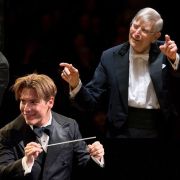
Kamensek kept a steady pulse throughout and sustained breathing space and clarity as textures formed and proliferated and rhythms collided in the purely orchestral passages which open and close the symphony and the Interlude. Farewell, with its text’s hope that all will be well as Lincoln says goodbye to Illinois to assume the presidency, ended quietly and ambiguously, Kamensek leaving it up to the audience to ponder whether that hope will be fulfilled. She and James helped the 89 year-old Glass out from the wings to accept the audience’s raucous standing ovation.


John Williams’ four film score excerpts maintained Lincoln on a human scale and with their nods to Copland provided the perfect bridge to the Lincoln Portrait, particularly in Getting Out the Vote’s hoedown. Elegy and With Malice Towards None featured some of the finest trumpet playing you’ll ever hear courtesy of principal, Thomas Rolfs.
Copland sculpts Lincoln onto Mount Rushmore with music. This is Carl Sandburg’s Lincoln as The Great Emancipator, giant amongst men, apostle of liberty and martyr to the cause. The texts are all from his presidency and feature the simple, yet soaring rhetoric which made Lincoln one of our greatest orators.
In general there are two ways to handle this narration: be another Olympian instrument in the orchestra like James Earl Jones or be simple, sincere and self-effacing like Henry Fonda and allow Copland to provide the larger-than-life hagiography. Though he seemed a bit detached and wasn’t always completely audible (despite being miked), Alec Baldwin opted for the Fonda approach. Kamensek provided the great man aura in spades, perfectly pacing the build up to a roof-raising, anthemic conclusion to close the concert.