Turning ninety has, for Zubin Mehta, become less a specific date than a global itinerary. Since the beginning of the year, he has been tracing the geography of his career in sound, returning to the major orchestras and halls that have shaped his presence. Berlin, where he has appeared regularly since the mid-1990s, formed an inevitable station on this arc. His longstanding friendship with Daniel Barenboim – for decades the defining musical force at the Staatsoper – has only deepened that bond.

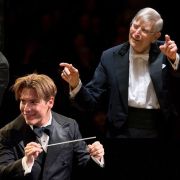
The sold-out house carried the atmosphere of an occasion with a capital “O”. Applause greeted Mehta’s being wheeled onto the stage with the warmth reserved for an old friend. Among those present were German Chancellor Friedrich Merz and Federal Minister of Culture Wolfram Weimer, alongside musical figures including Barenboim, Christian Thielemann and Elisabeth Sobotka, a quiet congregation of political and artistic power.


The programme was disarmingly direct: Mozart’s Symphony no. 40 in G minor and, after the interval, Beethoven’s Seventh Symphony. Familiar works risk becoming vessels of habit; here, they were treated as sites of return. At the helm sat a conductor for whom technique has long ceased to be a question. The Staatskapelle Berlin responded with due refinement, but virtuosity was not the point. What emerged instead was a study in musical relation: how sound is shaped when authority yields to trust.
Mehta’s physical language has, of necessity, contracted. Expansive gestures have given way to a vocabulary of economy – glances, nods, small inflections of the baton, a nearly private dialogue between podium and players. This reduction sharpened attention. One became aware of the space between impulses: the slight delay before a phrase settles, the breath preceding an entry. Tempi inclined toward the spacious, sometimes broader than convention, yet never inert. They seemed calibrated to an inner pulse, allowing the music to unfold with natural inevitability.
In Mozart’s G minor Symphony, this approach illuminated the work’s unsettled terrain. The opening hovered rather than pressed forward, each phrase suspended long enough for its harmonic tension to register. Urgency became reflection, motion generated from within.

After the interval, Beethoven’s Seventh followed a similar logic. Mehta resisted sheer propulsion. The Allegretto acquired a grave, processional quality, its repetitions shaped with near-meditative patience. In the other movements, rhythmic vitality remained, tempered by breadth, a reminder that ecstasy need not be breathless.


What lingered throughout the evening was an acute sensitivity to what might be called the phenomenology of musical time: those infinitesimal silences between notes where tension gathers and meaning coalesces. Mehta dwelt there, allowing transitions to speak as eloquently as themes. Bittersweet inflections in Mozart, quiet exultations in Beethoven – these emerged not as imposed interpretations, but as discoveries in listening.
The image of the conductor assisted from his wheelchair carried poignancy, but this was not a narrative of frailty. It was one of persistence, musical authority residing not in physical command but in accumulated understanding. When Mehta acknowledged the prolonged ovation, there was no sense of closure, only continuation.
In an era preoccupied with velocity, this concert offered something rarer: an argument for depth over display, for listening as an active force. The magic lay not in any single gesture, but in the totality of attention brought to bear on music that still reveals new contours to a patient ear.