| Année de naissance | 1926 |
| Nationalité | Hongrie |
| Époque | Contemporain |


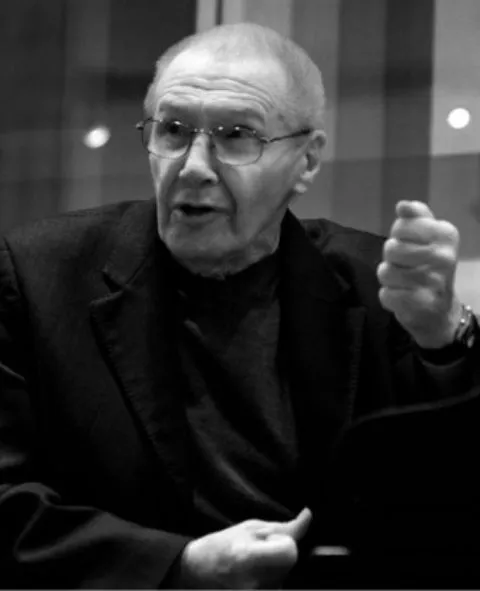
Hungarian composer whose concise and aphoristic works, forged from a variety of 20th-century influences yet distinctive to himself, have won him increasing recognition in the decades leading up to his 100th birthday.
Born in Romania, he moved to Hungary in 1946 to study piano, chamber music and composition at the Budapest Academy of Music, where he met his wife Márta Kinsker – a lifelong help, inspiration and piano duet partner – and established a friendship with fellow composer Győrgy Ligeti. He took Hungarian citizenship in 1948. Early works such as the Violin Concerto show the perhaps inevitable influence of Bartók, but after attending the composition classes of Messiaen and Milhaud at the Paris Conservatoire in 1957, his music fell under the influences of Webern, Boulez and Stockhausen. The new direction was signalled by the String Quartet of 1959, which he labelled his Opus 1.
Kurtág’s output has emerged at a slow pace, perhaps partly because of his heavy involvement in teaching, but also as a result of his meticulous, intensely focused craftsmanship. His works are fragmentary and in the moment, with movements often lasting just a few seconds, yet can be built into substantial cycles, such as the 12 Microludes for string quartet (1979) and the 40-movement Kafka Fragments for soprano and violin (1985-7). Játékok, a monumental series of piano miniatures that playfully reference across a wide range of music history, were begun in 1975 and are still being added to, currently standing at ten published volumes. Thus, despite the stillness of individual movements or sections, the larger effect can be of strong dramatic contrast and emotional power, as in the work that brought his international breakthrough at its Paris premiere in 1981, the 25-minute Messages of the Late Miss R.V. Troussova for soprano and chamber ensemble. Kurtág’s first opera, Fin de partie, a setting of scenes and monologues by Samuel Beckett, was premiered in Milan in 2018, and was well received: ‘the dramatic directness of Monteverdi and the extreme instrumental compression of Webern’, wrote Andrew Clements in The Guardian.
Many of Kurtág’s short pieces were written as memorials and homages to friends, colleagues and musical figures from the past, giving them an intensely personal and human quality. Among their subjects is his beloved Márta, and it is hard not to suppose that her death in 2019 was the prompt for his one-act monodrama Die Stechardin. Based on writings by the 18th-century polymath Georg Christoph Lichtenberg and scheduled for its world premiere in Budapest six days before the composer’s 100th birthday in February 2026, it ponders love beyond the grave.
Profile © Lindsay Kemp, 2026