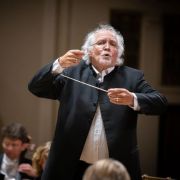
For an exacting performance of Beethoven and Bruckner, it’s not necessary to have a German orchestra. But it certainly helps, even – and maybe especially – with Scottish conductor Sir Donald Runnicles on the podium and American soloist Emanuel Ax at the keyboard. The Dresden Philharmonic also brings a 156-year history with the Romantic repertoire, played with refined elegance in a guest appearance in Prague.

From the opening bars, Beethoven’s Piano Concerto no. 2 in B flat major sounded authentic – which is to say, noble, dynamic and at times thrilling. To give Beethoven impact, many conductors like to render his music up-tempo and loud. Runnicles offered a more measured approach, energetic but not aggressive, authoritative without the volume. Granted, an early concerto is far removed from the late symphonies, with their heavy hammer blows. But Runnicles’ softer treatment let the music unfold with grace and a fine rhythmic feel, offering balance, melodic flow and superb accompaniment for the soloist.
Ax played with a soft touch as well, and with tempered backing from Runnicles, was never overwhelmed by the orchestra. The pianist’s approach was straightforward, with just enough flair to give the music spontaneity and a lyrical ringing quality. Runnicles also provided expert set-ups for the piano solos, leading listeners right up to the brink of the next phrase, handed off neatly to Ax. This worked particularly well for the cadenza in the first movement, a notoriously complicated passage that the veteran pianist made look easy.
Ax changed gears in the second movement, striking an almost meditative tone while imbuing his playing with more color. That matched gentle accompaniment by the orchestra, so hushed that at times it was almost imperceptible. The final movement started on a livelier note that Runnicles spun up into a spirited frolic, enhanced by sparkling work at the keyboard. In passages where the piano was accompanied only by the woodwinds, the sound was golden. And the tricky interplay between orchestra and soloist that finishes the piece was pulled off with aplomb.

Bruckner’s Seventh Symphony reflects the weighty influence of Wagner, starting with its 70-minute length, inviting overbearing treatment. But once again Runnicles showed a light hand, keeping the grand dimensions but focusing mostly on rich expression. Bright woodwinds were in the forefront throughout, and the strings ran a full and impressive range, from silken to soaring. There were occasional lapses: the brass were inconsistent, brilliant at times, bordering on sour at others; and the Adagio got off to an awkward start, not quite coalescing until halfway through the movement.
Otherwise, the symphony offered a masterful display of dynamics. Runnicles’ skill in pacing, building surges and crafting compact percussion gave the music a distinctive character. And he was not averse to turning up the volume at propitious moments – the heroic finish to the first movement, the growing excitement of the third. Overall it was a remarkable combination of sensitivity and control, a personal reading of the piece with careful attention to detail that gave it accessibility and broad appeal.

The musical ties between Prague and Dresden go back centuries, and include names like Zelenka, Mysliveček and Benda; Bedřich Smetana even has a street in Dresden named after him. This performance added another noteworthy chapter to that storied cultural history.