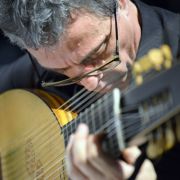
Three members of the long established Italian vocal ensemble La Venexiana, soprano Emanuela Galli, harpist Chiara Granata and director-theorbo player Gabriele Palomba, gave this rich programme of 16th- and 17th-century Italian music. This “New Music” as it was then called, was in part a conscious attempt by groups, whether in “Academies” or Ducal courts, of artists and intellectuals, in Florence, Ferrara and elsewhere, to regain what they believed to be the spirit of ancient Greek art.

These origins can vary according to which scholar you read, but certainly Giulio Caccini (1551-1618) published in 1602 a volume called Le nuove musiche (The New Music), and which has been treated as much as manifesto as music. The style leaves behind the prevailing polyphony of the century just closed, announcing the Baroque era with monody for single voice and instrumental continuo. The latter was founded on a bassline over which accompaniment was improvised according to prevailing conventions (so did not need writing down). Melodies reflected the text and Caccini even instructs his singer how to deliver and decorate his melody, to intensify the emotional impact, with pulsations on single notes, trills, rapid runs and flexible dynamics.
Soprano Galli was well versed in all this, opening with three items from Caccini’s Le nuove musiche. Dolcissimo sospiro offered indeed that “sweetest of sighs” with many a falling interval to lean upon, and Galli’s decorum in use of expressive devices was just right. Her diction was not always impeccable in the early pieces but she soon gained the requisite textual focus. In Belle rose porporine the flowers inspired a more dancing response, and after Amarilli, mia bella Amaryllis could never doubt how much she was loved. But in Sigismondo d’India’s Cruda Amarilli Galli conveyed well the punning and cruel “signs of bitterness”, the amaramente insegni .

Perhaps the gem in this crown of thorns – for few of these numbers avoid mention of love’s anguish – was Tarquinio Merula’s Folle è ben si crede (Foolish indeed is any who believes they could part me from my love). It was the most positive of the poems and the most attractive of the scores. It celebrates unbreakable constancy with taste and tunefulness, and the BBC (broadcasting live) was wise to instruct us to restrain from applause until after that item. But the musical level was maintained by Barbara Strozzi in the next item, her L’Eraclito amoroso (Heraclitos in love). Gallo’s committed singing was well accompanied by the two instrumentalists, and Chiara Granata’s harp sounded historic yet enchanting in its solo items.

Monteverdi’s Voglio di vita uscir (I wish to leave this life) closed this lovelorn programme with its most, perhaps only, familiar work. Its musical mannerisms, a repeating bass motif to reflect an obsessive mood, with the dissonance and chromatic melodies of languishing lamentation, were symptomatic of much of the repertoire presented here. Hearts were no doubt broken in all eras, but these early Baroque Italians really turned it to fine musical advantage. Monteverdi’s song Ecco di dolci raggi il sol armato, at one minute long perhaps the briefest of all his Scherzi musicali, made an ideal encore. Here as in the whole programme, Galli’s impressive memory for music and text meant she needed no score.
So, a very agreeable hour spent in a large and elegant marble-bedecked room in a palace somewhere in 17th-century Italy – yet miraculously available on BBC Sounds for the next month.