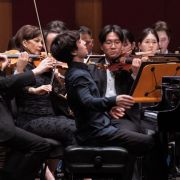
Music runs in families. There were the Bachs, the Mozarts and the Mendelssohns and, more recently, the Sanderlings and the Järvis. Two grandsons of great Argentine pianist Martha Argerich, 19-year-old Roman Blagojevic and 17-year-old David Chen, have now joined the worldwide concert circuit. Their 2026 Legacy Tour with the Thailand Philharmonic Orchestra, led by Argentine conductor Dario Ntaca, included concerts in Bangkok and Singapore.

Blagojevic is the son of Argerich’s third daughter, Stéphanie, director of the Argerich family docu-movie Bloody Daughter, and grandson of American pianist, Stephen Kovacevich. He appeared tense and ill-at-ease in Bach’s Keyboard Concerto no. 5 in F minor (BWV.1056) but was able to project and articulate with clarity, with accompanying strings kept as discreet as possible. Entering a bar late in the Largo could have derailed the movement, but the aria’s elegance, partnered by string pizzicatos, was sustained through its short duration. The brisk and business-like run-through in the finale suggested he was more comfortable away from the stage.
David Chen is the son of Martha’s eldest daughter, viola player Lyda Chen-Argerich, and pianist-composer Vladimir Sverdlov-Ashkenazy (nephew of Vladimir Ashkenazy). He was by far the more confident of the two, possessing nerve and chutzpah to take up the challenge of Tchaikovsky’s Piano Concerto no. 1 in B flat minor. The striding chords of its famous opening were resonant and well-projected and the cadenza showed he clearly had fingers for the well-worn warhorse.
Chen channelled his grandmother’s fiery temperament but also the tendency to rush fences, as if on a whim. When Martha transgresses, it is through authority and instinct, but for someone this young, impetuosity and indiscipline are the more likely reasons. The slow movement was somnolent until sparks flew in the Prestissimo, and the finale was a race of the fastest thoroughbreds, the stampeding octaves culminating with that rolled Horowitz-like chord. Undeniably brilliant in the final pages, the audience was thrilled, but Chen is still scaling a steep learning curve.

Each pianist had a four-hands encore with Ntaca, in movements from Ravel’s Mother Goose Suite. Chen, who received longer and louder applause, also offered Chopin’s Mazurka in C major, Op.24 no.2, displaying more liberties and a free spirit.
The Thailand Philharmonic was more accompanist than partner in the concert’s first half, but had its own show for the balance of the evening. Founded as recently as 2005, it has since made rapid progress. I have witnessed very commendable performances of Mahler, Sibelius, Schoenberg and Shostakovich at its 2000-seater Prince Mahidol Hall in the outskirts of Bangkok. Its touring programme was, however, to be lighter and more popular.
Directed from memory by Ntaca, Brahms’ Academic Festival Overture received a suitably rousing performance. The orchestra, peopled mostly by young Thai nationals with a handful of expatriate musicians, generated the impetus and momentum for its succession of popular drinking songs. By the time the valedictory Gaudeamus igitur rang out, brass and percussion were at full throttle for one final carouse.
More substantial was Tchaikovsky’s fantasy-overture Romeo and Juliet which revealed more of the young orchestra’s qualities, including proficient woodwinds and a sonorous bass of low strings. There was no shortage of passion for the Montague and Capulet feud, later rising for the memorable love theme which swept the board.
This concert was presented by Altenburg Arts and 54 Entertainment