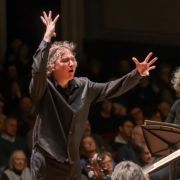
1788 was a pivotal year in the Austrian Empire, marking the start of the Habsburg-Ottoman War, a costly three-year affair in terms of both forces and money. Taxes skyrocketed and the mood turned ugly in Vienna, where bread riots broke out in the streets after a terrible harvest, compounding the misery. Mozart and his family relocated from the city centre to a suburb, but there was little appetite for concerts, let alone cash for commissioning new work. Mozart normally wrote to deadline, but composed his final three symphonies concurrently over just eight weeks with no performances scheduled in the bleak capital. Whether seen as a trilogy or a 12-movement arc, it is a brilliant showcase of a composer at his peak. Conductor Maxim Emelyanychev, a whirl of creative energy, lifted the music from the score and delivered it with a vibrancy of rediscovery.

Emelyanychev conducts with neither podium nor baton and is balletic on his feet, his whole body describing the music in detail. He clearly shows us what he wants, the 40 Scottish Chamber Orchestra players responding to his infectious energy magnificently. I particularly liked the orchestral sound with violins arranged antiphonally, cellos (no spikes) and violas in swapped positioning with three towering double basses raised at the back behind the woodwinds, period horns and trumpets adding colour, and a delicious barking exuberant edge when underpinned with the rolling timpani.
The Symphony no. 39 in E flat major opened with ceremony and grandeur, the strings percussive, each section perfectly balanced against the majestic fanfares. Elegant phrasing in the slower second movement became more muscular as the music developed, marching briskly along in the mischievous third, a vibrant clarinet duet adding colour and energy. A witty final Allegro had Emelyanychev’s arms going in circles, playing games with Mozart’s sunny themes as the horns added piquant personality to the lively sound.
A more shadowy work despite its familiar opening, the elegant initial theme of the Symphony no. 40 in G minor pushed along towards a stormier development. Chirruping flute and clarinet were bright interjections in the calmer and more serious Andante. The Menuetto was lively, Emelyanychev swinging it exuberantly, before the serious finale which was more intense, players all leaning in together, listening to each other in the central angular development before the music resolved back in the minor key.

The immense Jupiter Symphony opened splendidly, themes traded across sections, woodwinds sparkling as Emelyanychev stepped towards each group, urging them on with a fearsome energy, players on the edge of their seats. A graceful muted string world with dissonant themes gave way to a brighter Menuetto before the complex and thrilling finale, the themes tied up in an electrifying fugue.
Emelyanychev’s detailed approach might be distracting to some, but he brought fresh reshaping to Mozart, putting his rocket-boosting stamp on the music. He made it sound brand new, absolutely embodying the SCO’s latest strapline ‘For the Love of Music’.