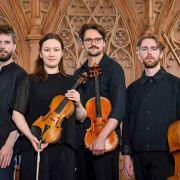
A big milestone needs a big celebration, and you have to give credit to Scotland’s East Neuk Festival for commemorating the 21st festival by throwing themselves into one of their most ambitious days ever.

Rather than quietly popping a champagne cork, the festival, which specialises in chamber music, decided to mount all three of Beethoven’s Op.59 “Razumovsky” quartets, played in three concerts by three different ensembled across one Saturday. The ambition paid off triumphantly, with performances of dazzling commitment and audiences who couldn’t get enough of what they were hearing.
Part of the success was the way each quartet used its distinctive sound. The day began with the Spanish Cuarteto Quiroga, who seemed to cast Mediterranean sunlight all over Razumovsky no. 1, bringing gentle assertiveness to the opening and building the whole sound on the marvellously rich tone of their cellist. It helped that they were playing in the ancient church at Kilrenny, a venue whose interior contains so much wood that its resonance makes it perfect for string quartets. The Quirogas used this to their advantage in the meditative stillness of the desperately sad slow movement, balancing the tiptoe exploratory lightness of the Scherzo.

Nos. 2 and 3 happened up the coast in the medieval church at Crail, where the Calidore String Quartet played Razumovsky no. 2 with dark, surging energy, bringing out all the unsettling drama of the minor-key music in a way that seemed to show that there was something dark and threatening taking place. Even the moments of light relief, like the Russian theme in the Scherzo, brought little respite from the intensity. The finale kept fully in step with the colour of the piece by seeming determined rather than cheerful.
Finest of all, however, was Opus13 playing Razumovsky no. 3. This Swedish-Norwegian quartet made its UK debut at the 2024 East Neuk Festival, and they have been showered with rewards and recognition ever since. Rightly so, because their playing here was revelatory: freewheeling, carefree and delightful, flying high but without the aid of a safety net. Even the genteel Minuet seemed to have an arch eyebrow raised, and they attacked the hell-for-leather finale with such energy that I half expected to see sparks flying from their bows. The audience positively roared its approval at the end, which isn’t something Crail sees very often.

As if that wasn’t enough, each Razumovsky also had a Beethoven-adjacent companion piece, the highlight of which came in the Calidore concert with the UK premiere of Mark-Anthony Turnage’s Arietta, inspired by the last movement of Beethoven’s final piano sonata. Influenced by Beethoven’s lyricism, Turnage created something achingly beautiful, full of earnest yearning and yet still boundary-pushing in the way its lines diverged and coalesced.
Qualms? I don’t know if I’d want to experience the Razumovskys in a single dose like this again. Six pieces for string quartet in just over six hours left me feeling wrung out, and all I was doing was listening to them! Still, if it was intense, then it was also unmissable, and an unforgettable way for the festival to celebrate its coming of age.