
The Belgrade Music Festival is now in its 58th edition and this year offers a fortnight of operatic, orchestral and chamber concerts with performers from Serbia and further afield. I have been fortunate enough to catch a Hungarian chamber orchestra and an outstanding Serbian piano trio. Amongst the visitors were the Sofia Philharmonic Orchestra conducted by their Artistic Director, Nayden Todorov, who brought a programme designed to demonstrate the strengths of his orchestra.

They started with a Bulgarian work: Veselin Stoyanov’s Festive Overture. This is a joyful, celebratory work from 1959. There were swooping strings, triumphant brass, some exotic touches (bringing Prince Igor to mind) and reminiscences of Hollywood. Curiously all these elements also featured in a rather subtler guise in the Rachmaninov Third Symphony that formed the second half of the concert. This overture was just right for a visit to a festival in a neighbouring country and the Sofia Philharmonic played it with gusto.
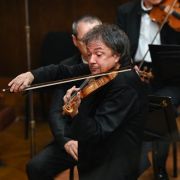
The orchestra was joined by Russian violinist Sergei Krylov for Mendelssohn’s ever-popular Violin Concerto in E minor. This is a concerto where unusually the soloist enters almost immediately without an orchestral exposition or introduction and from Krylov’s very first notes it was clear that this was going to be a special performance. His beautiful tone sang out over the orchestra. Sometimes lightness and delicacy are to the fore in this concerto, but Krylov’s reading was much more muscular, revealing some of the darker undercurrents lurking in the music. I loved his robust approach. Mendelssohn’s glorious melodies flowed unstoppably throughout. He also injected some pleasing humour from time to time, dazzling with his virtuosity, especially in the finale. Krylov received fine support from the orchestra (a larger one than is often deployed for this concerto) but the focus was almost always on the soloist.

Rachmaninov’s Symphony no. 3 in A minor completed the programme and this is where the Sofia Philharmonic really came into its own. In lesser hands it can feel disjointed and episodic as there are many different contrasting moods that follow in quick succession. Todorov ensured that while the focus kept shifting, the result was a magnificent whole. In the first movement the mood could switch from mystery to jollity, from a sweeping cello tune to a perky woodwind outburst, in a moment. Todorov marshalled his huge forces with care, controlling the overall ebb and flow of the music and highlighting the little details from orchestral soloists that give this symphony a special flavour. In the second movement some of the contributions, for example from the harp, celesta and flute, gained a prominence that is rarely achieved. In fact, throughout the symphony I found myself noticing intriguing combinations of instruments that I did not remember from previous hearings. The fine acoustics of the Kolarac Hall no doubt helped. It was not just a matter of fine detail, though. When the whole orchestra came together they did so energetically, driving along the complex rhythms and stunning with the explosive chords that are also characteristic of this symphony.