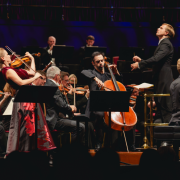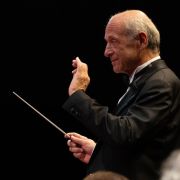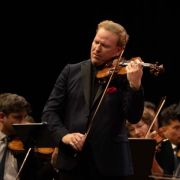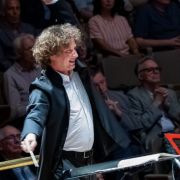


When John Wilson first assembled an orchestra to record Erich Wolfgang Korngold’s Symphony in F sharp, he little thought it would be the start of a new musical phenomenon. But ever since, the trajectory of the Sinfonia of London (SoL) has been upwards, meteorically so. Their Proms have become regular highlights. Their recordings scoop award after award. This week they tour the UK. “Everything has wildly exceeded my expectations,” Wilson says.

It has not come from nowhere. The SoL was originally formed in 1955 by the flautist Gordon Walker for recordings and film scores. In 1982 the composer Howard Blake and the orchestra manager Peter Willison acquired the title so that The Snowman would use a named orchestra. Wilson, who had been Blake’s assistant while a student at the Royal College of Music (RCM), bought the rights to the name from them.
The new-look SoL’s initial purpose – recording – matched the original mission. In the first year, 2019, the orchestra made three recordings: the Korngold, an album of French music and the Respighi Roman Trilogy. Even that much, Wilson says, was a surprise.
“We’d only started the orchestra to make the Korngold recording, because I felt passionately that the piece needed a different take,” he recounts. “I felt that its technical challenges needed an orchestra that could grab the bull by the horns. I’d got to understand so much of Korngold’s world and his language that I just wanted to be in a room with 100 people who bought into that. Then we had some session time over, so we made the French record – and soon everybody was enthused.
“I was getting so much energy back from these players who really wanted to be here that I felt it was my moral obligation to put as much time and energy behind this as possible.” The Covid-19 pandemic, during which he was forced to stop and take stock, sealed the deal: he realised that after it the SoL would be his absolute priority.


Now Wilson and the SoL have an expanding mission statement: “Our ethos is that we want every concert to be an event, whether it’s in the Musikverein in Vienna or a sports hall in Cumbria. Everybody in the orchestra is excited every time we meet because it’s not a full-time job. There’s a sense of real occasion, and we want to transfer that through the concert to the audience.

“We’re one of few orchestras who do regular nationwide tours. We love building new audiences around the country, and we see ourselves as a UK orchestra with ‘London’ in the title. It’s easy to talk Britain down these days, but I’m determined to take my orchestra all over the country and play to these wonderful people who love music. We exist for the composer and the audience. If you really honour the composer, the audience will leave the concert nourished and satisfied.”
In the ranks you can spot section principals from the UK’s top orchestras, string quartet members, sought-after freelancers and more. “Most orchestras,” Wilson says, “have played Scheherazade a million times, whereas my players are ringing me up saying how excited they are to do it for the first time – because many of them are normally in chamber groups, not orchestras.”
Rimsky-Korsakov’s technicolour symphonic poem is the culmination of a programme for this tour that also includes the Polish composer Grażyna Bacewicz’s Concerto for String Orchestra and Rachmaninov’s Piano Concerto no. 2, with the pianist Benjamin Grosvenor, who had had to drop out of that work due to illness when the SoL brought it to the Proms a few years ago. At that performance, the sheer intensity, opulence and virtuosity of the SoL’s playing nearly knocked me off my chair.
Orchestras normally do not sound like that these days. Certainly not in Britain. How does he do it? “The strings are the DNA, the lifeblood, of an orchestra,” Wilson says. “Orchestras evolve from the string sound outwards, and if you play a lot of late Romantic music, there needs to be very tight focus on that. You could say it’s an old-fashioned sound, but for me, the golden age of fiddle playing was the time of Jascha Heifetz, Nathan Milstein, David Oistrakh…” He asks all his string players “to play out and to play up to the fullest of their capabilities and expressive range”.
Part of his ideal comes from the powerhouse American orchestras of the early to mid-20th century: the Cleveland Orchestra under George Szell, the Philadelphia with Eugene Ormandy, the Chicago Symphony Orchestra and Fritz Reiner. It was not only the string playing (probably fed by the Hungarian tradition of string sound that those conductors brought with them) but also their culture of sterling professionalism.
“Neville Marriner said that there was a level of discipline in the Cleveland Orchestra worth two days of rehearsal anywhere else. You play with the beat. The dynamics are non-negotiable. There’s discipline with the bow. These seemingly dull technical things are very liberating. Within that set of clear parameters, you can completely be yourself.”
Wilson has had a hands-on approach to conducting from the start. He grew up in Gateshead, where as a teenager he frequented the music library and set about arranging pieces for a small ensemble. In the sixth form, he tackled West Side Story. Today he is well known for creating his own forensically researched performing editions – everything from Ravel’s Daphnis et Chloé to Oklahoma!
He is famous, too, for a seemingly tireless work ethic. “I’m quite exacting about what I want,” he says. “I’m obsessed with detail. Somebody once said to Stephen Sondheim, ‘The devil’s in the detail,’ and Sondheim said, ‘Actually, no: God is in the detail.’” Programme building is another obsession: “I almost send myself loopy trying to find the perfect programme.”


His latest SoL recording is a case in point: a follow-up to their earlier, rapturously received recordings of English music for strings. Britten’s Serenade for Tenor, Horn and Strings was the starting point. “We were on tour with Laurence Kilsby and Christopher Parkes doing this piece, and I thought we can’t not lay it down. So we recorded it, and then I just dragged as much knowledge of the English string repertory out of my memory as I could. I thought also of Boyd Neel [the conductor who founded his own orchestra in 1932] because he commissioned a lot of music which exists because of him.”
The result unites Britten with Goossens, Ireland and Walton. “We forget that Goossens was a composer because he was so famous as a conductor, and I’ve always loved By the Tarn since hearing Richard Hickox conduct it when I was a kid.
“John Ireland is a composer who’s immensely important to me. When you fall in love with his music, you fall in love with it completely: his world is so personal and so subtle. When I was a student, my piano teacher was Alan Rowlands, who had studied with Ireland and became the first person to record all his solo piano music. I remember operating the slide machine for two lectures that he did at the Royal College of Music on Ireland. By the end of the second one, I was totally intoxicated by this music.
“But the real killer piece, for me, is the Walton Sonata for Strings, a reworking of a string quartet. I think that it’s the best thing he ever wrote, along with Troilus and Cressida, and it has the single greatest slow movement he ever created.”
The recording is also exceptionally personal. Wilson’s father died while the sessions were in progress. “I got the call in the tea break, and then I had to go and conduct that slow movement,” Wilson says. “My legs were giving way, but the orchestra was sharing in my grief, and it’s palpable in that performance. I will never forget the experience of the orchestra being there for me.”
It seems amazing that anyone could press on under such circumstances, but – “My dad would have absolutely bollocked me if I hadn’t!” Wilson declares. If he has a tough work ethic, it’s clear where it comes from. “In my second week at the RCM, I decided I didn’t like it, and I was so homesick that I got the train back to Newcastle. My dad gave me a cup of tea, then drove me straight to the station, and put me on a train, saying: ‘I’m not letting you do this’.”
Ever since, he’s been unstoppable. As for next year, there’s another musical in the can, with all Wilson’s usual obsessive attention to detail and editorial correction. It’s West Side Story. “It was like climbing the north face of the Eiger,” he says darkly. I can’t wait to hear it.
John Wilson and the Sinfonia of London with Benjamin Grosvenor are on tour in Basingstoke, the Barbican, London, and Saffron Walden from 4th–7th November.
The Sinfonia of London’s recording of Britten, Walton, Ireland and Goossens is out on Chandos this month.
See upcoming performances by John Wilson and the Sinfonia of London.