Life as a young musician in the UK has never been particularly straightforward. But in the past 15 years it’s striking just how precarious things have become. The setbacks and crises are so familiar it’s wearying to even list them. Thus, it’s gratifying to see at least one healthy institution placing emphasis on supporting careers of young music professionals. Chromatica Orchestra, which made its re-founded debut in 2024 at Battersea Arts Centre, has a mission to bring together young musicians, conductors and soloists, giving that crucial early basis of professional support. Oliver Cope, 27, has just been appointed the orchestra’s first Principal Conductor.

“I think in the UK we’re actually particularly unlucky – my generation, just as we start,” Cope says. “I began my undergraduate in 2017. Brexit was a year before that, and then at the end came Covid. Those two landmarks have made things tricky.” As a music professional, Cope is hardly alone. The difficulties facing the arts sector in the UK run much deeper, and today the crisis in UK grassroots music education is especially acute.
It’s something Chromatica is well aware of too. Formerly Bath Festival Orchestra, the ensemble was relaunched in 2024 as Chromatica by its founding artistic director, conductor Peter Manning, with a new base in South London. Regularly performing in Battersea, the orchestra has developed close partnerships with the Music in Secondary Schools Trust and Newham’s Bobby Moore Academy.
Given Chromatica’s player body, of young professionals and freelancers, I ask Cope if he thinks that this offers an advantage to gaining the interest of younger audiences? “Absolutely. The thing everyone wants is younger audiences. One of the things Chromatica does – and will continue to do – is to have different members of the orchestra introduce the pieces. I do think younger audience members take more interest if someone of a similar age is talking to them directly about the music.”


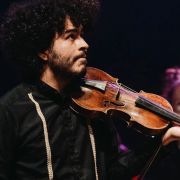
In October, Chromatica opens its season at Battersea with a visit from Sarang Seohyun Kim, who stormed several prominent string competitions (including the Tibor Varga and the Ysaÿe) winning first prizes in her early teens. In her debut with a UK orchestra, she will perform Korngold’s Violin Concerto on her 18th birthday.
Normally there can be an age disparity between a soloist prodigy and creaking orchestra, but not in this instance. “There’s something about the quality of playing of younger, fresher ensembles which is different,” Cope offers. “Not necessarily better or worse, but it has a certain kind of edge and excitement to it. I think part of my role, and part of my desire at least, is to experiment and see what we can do while we find our brand. To find our niche and to try some new things.”
Cope, who earlier this year was himself a prize-winner in the Mahler Conducting Competition, won the role with Chromatica in a competitive audition. “A number of us, four in total, were contacted through recommendations, conductors of a similar age, between 25 and 35, to audition with the orchestra. Everyone was invited to lead a session for three hours, to bring a piece of repertoire which fit”, he says.

Cope had the feeling that “as the orchestra was developing, they really wanted a principal conductor – someone to take a more central role in helping create programmes, shaping its brand and its sound.” He will lead the majority of around ten concerts given this season – with the autumn and winter concerts already on sale, spring and summer are yet to be announced.
The conductor’s role is hardly limited to rehearsing and performing either. “The job is multifaceted, as any musical director’s is,” Cope says. “To be the face of the orchestra, with audiences and donors, as well as programming and planning: who’s playing in the orchestra, where we play, who we invite as soloists, who we invite as guest conductors.” The need to make the right decisions, for the wellbeing and future of the whole orchestra, is daunting.
Cope is frank about the need for Chromatica to find its distinctiveness. “The thing which whirls around in my mind is we don’t really need another orchestra. If you want to go and watch a programme of a concerto, overture and symphony, there are many very good orchestras in London you can go and see.” He names a few of the usual suspects in the capital. “But actually, I think there is room for a new orchestra with some ideas, wanting to present things a little more of a fresh way, in a new part of the city, in a new space which isn’t used so much.”
Battersea Arts Centre in fact is an enviable acoustic in a city famously starved for decent performance spaces. And perhaps Chromatica will find its way elsewhere too. London’s classical musicians are well-used to getting out and about – from Pierre Boulez’s BBC Symphony Orchestra concerts at the Roundhouse in the 1970s, to more recent performances at Bold Tendencies in Peckham’s Multi-Story Car Park.

Cope has also been conducting opera in Battersea, with British Youth Opera’s Rake’s Progress which ran at BAC in August. He hopes to continue. “The musical experience is some of the richest you can get as a conductor. I think it’s good for orchestras as well.” He hints that Chromatica could well be mobilised for an operatic occasion.
Film drama, too, seems up Chromatica’s street. In its opening programme, alongside the Hollywood-infused strains of Korngold’s Violin Concerto, the orchestra will perform Bernard Herrmann’s caustic Psycho suite, as well as the pitch-perfect sarcasm of Shostakovich’s Ninth Symphony. (“Exactly the same year as the Korngold, but other side of the world,” Cope points out.)


Then, in the orchestra’s following concert, Chromatica welcomes another youthful soloist, accordionist Ryan Corbett, for a concerto by young composer Daniel Soley, premiered by Corbett in 2024. “Ryan is the first ever accordion player to be BBC Radio 3 New Generation artist. I think the accordion is becoming quite in-vogue – there’s a lot of accordion players doing cool things at the moment,” Cope says. The Accordion Concerto is combined with music from Argentinian composer Osvaldo Golijov written in tribute to Piazzolla, as well as Poulenc’s dance-infused Sinfonietta.

I ask Cope what first drew him to conducting – after all, standing up in front of musicians can be a daunting prospect for any young performer. “I was a harpist – that was my main thing when I was growing up. I thought for a very long time I would become a harpist.” Following his horn-playing mother into amateur ensembles, “I ended up getting roped in for free, basically. I was quite happy to do it and harpists are quite expensive!”
Gradually, Cope “became interested in what was happening at the front. I always liked orchestral music – I listened to a lot. Basically, the way I got into it was striking a deal. I said: look, I’ll keep doing this for free, but maybe I could try conducting?” And so it was that Cope bargained his way into conducting Berlioz’s Symphonie Fantastique. “I think I was 15.”
Cope continued conducting as an undergraduate but it was only later that he had any formal conducting lessons. “I founded my own little orchestra. We did opera and symphonic stuff – there was loads to do. And I think doing that without any conducting lessons was quite a good thing for me – you do figure out how to get things done and be calm about it.” It’s remaining calm when things go wrong that I find difficult, I say. And, of course, there’s so much else necessary to the role: creating good vibes from the podium, making players feel confident and secure.
“My main thing,” Cope replies, “is to try and create an atmosphere where everyone in that room is enjoying what they’re doing. That they feel that what they’re doing is important. That we’re trying to make something for the right reasons, that we’re trying to create real music. Good rehearsing and a good rehearsal room is when you create an environment where everyone wants to achieve a certain thing, everyone wants to do it well. You can have the most amazing technique and the most amazing ears – but if there’s something you’re exuding, or your character, or what you’re asking which doesn’t get everyone behind you, I don’t think the results will ever be as good.”
“I think sometimes we forget that music-making is meant to be fun!” Cope adds. “I know this is something sportspeople talk about a lot – that when you get to a very high level of sport, you can forget that this was a game you played as kids. No one’s going into the music profession to make money, or to achieve stability or security in any way, because it’s so hard! We all do it because, ultimately, we find it fun and we think it’s important.” Amen.
Chromatica Orchestra and Oliver Cope launch their season with Sarang Seohyun Kim on 14th October at Battersea Arts Centre.
See upcoming performances by Chromatica Orchestra.
This article was sponsored by Chromatica Orchestra.