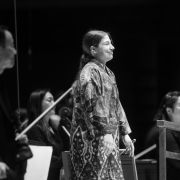
Growing up in a musical family, it was inevitable that Meggie Murphy would pick up an instrument herself. Murphy – a trombonist and recipient of a LSO Conservatoire Scholarship – first began her studies at the age of nine, but by that time, music was already a deeply ingrained part of her home life.

“I have three half-siblings and a brother, and they play string instruments, and both my brother and half-brother play trumpet,” Murphy tells me in a recent interview. “I said to my dad, I like the sound of the brass!”
Her father, however, wasn’t keen on the idea of another trumpeter in the family. “My brother and I are very close in age – so he was probably thinking, let’s not do the same thing,” Murphy said. “So he said, what about the trombone? And I just said yes not knowing anything. I walked into the first lesson and literally had the shock of my life. I was expecting a valved instrument, because I’d only ever seen valves. But I played it and loved it.”
Murphy’s musical education kicked into high-gear almost immediately, and within several years of her first trombone lesson, she was already participating in the National Children’s Orchestras of Great Britain’s Under 12 programme. At 13, she began matriculating at Wells Cathedral School, where her professors prepared her for music college and the life of a professional player. Instantly, she was hooked.
“Apparently I came home to my mum and said, I want to do this, I want to do this!” Murphy recalls. “I was like: Oh my god there are so many other people who really like to do it! It’s not weird or unusual.”


Like many early-career musicians, Murphy found herself attempting to balance the requirements for establishing herself in a career with the financial barriers associated with further training, practice requirements and travel to jobs around the UK. “In my head, that was the time to really push things,” she says. “You want to start setting foot in the world, and that’s really hard if you’re trying to do a job on the side as well. Focusing on studies and audition preps takes so much time. The world is unstable already.”

Yet Murphy rose to such challenges with tenacity. After a stint in the National Youth Orchestra of Great Britain, at the age of 19, Murphy achieved a place as brass finalist in the prestigious BBC Young Musician of the Year 2020 – a competition that in past years had helped launch fellow trombonist Peter Moore’s career. Murphy later won the Musicians’ Company Brass Ensemble prize with group Solis Trio, and was awarded the British Trombone Society’s Student of the Year. After studying at the Royal Academy of Music, with the support of the Elton John Scholarship, Murphy eventually took on a masters in trombone at the Royal College of Music, with support from the LSO.
The support offered by the LSO Conservatoire Scholarship came at just the right time. Murphy saw a posting for the programme online, which is open to pre-professional and early career musicians who face financial barriers for continued study. The programme also provides mentorship opportunities by pairing recipients with LSO members who can speak to their own experiences as professional musicians. Murphy applied and was accepted, which opened new professional doors as a young musician.
“I read the criteria and realised that I slotted into it,” Murphy says. “Doing a postgrad degree is really expensive, so I was already looking for funding. It’s not possible to do a postgrad without funding for a lot of people. The LSO scholarship is so generous that it wiped away any other real insecurities I had.”
Murphy speaks fondly of her experiences interacting with LSO musicians – particularly her mentor, second trombone Jonathan (Jonny) Hollick. “The LSO is an amazing orchestra, so any bits of advice they’re willing to give is extremely helpful,” she said. “Specifically in my lessons with Jonny, we did a lot of audition-type scenarios, which is a big thing you need to prepare for at this stage of my career. He was so helpful.”
Murphy emphasises that the professional mentorship she received allowed her to ask questions about career-related matters that don’t always come up in college. “As an undergraduate, you’re trying to master the basics, and I probably didn’t ask a lot of questions about the professional side of the business,” she noted. “But having a mentor like Jonny who’s a professional makes you feel more free to ask those questions.”


Another benefit of the scheme was the chance to connect and play with other musicians at a similar stage of their careers. “We did a big concert with a lot of the LSO scholars, and I got to meet so many people through that,” Murphy says. “The conversation was quite easy because we were talking about the scholarship, what it’s done and how it’s helped each one of us. It was nice to relate to everyone in that way. Nothing felt like a taboo subject, and we were all getting to do what we love, which is why we applied in the first place.”
For any musician in the UK coming from a relatively humble background, the barriers to becoming a professional are manifold. With musical opportunities at a grassroots level suffering from disinvestment, and fewer school music departments able to offer instrumental tuition or Music A Level, it can be especially difficult for young musicians to progress. And if one is able to do so, university level music education is expensive, and later career opportunities highly competitive. As Murphy acknowledges, the financial difficulties of establishing a career as a professional musician can be significant. But she expresses gratitude toward the LSO, particularly at a time when many UK cultural institutions are struggling to maintain funding amidst squeezes to public funding, and unstable private philanthropy.

“I just hope the music keeps going,” Murphy said. “It’s an unstable industry, and you watch certain organisations go down the drain a little bit. Being young in this world makes you wonder if things will be there later for you when you reach a certain stage in your career. I want to keep playing with as many people as I can and enjoy that.”
Murphy’s gregariousness is evidenced by a wide range of freelance work already taken on with British orchestras and ensembles, including the Royal Philharmonic, the Philharmonia, and Aurora Orchestra, among others. She has been on trial with the English National Ballet and the Royal Scottish National Orchestra – though as ever, stability as an orchestral musician in Britain is never a certainty.
But as she moves into the next phase of her career, Murphy had one strong message for any young artists considering the LSO Conservatoire Scholarship.
“Do it, 100 percent,” she said. “You have nothing to lose and so much to gain. Financial security is a massive part because it eliminates a lot of anxiety, but getting to work with mentors just opens up a world of possibilities.”
The LSO Conservatoire Scholarships Scheme is open to postgraduate instrumentalists of any age or nationality who fulfill the eligibility criteria.
The application deadline is 12pm on 10th March 2026. More information for applicants is available here.
This article was sponsored by London Symphony Orchestra.